Doomreader

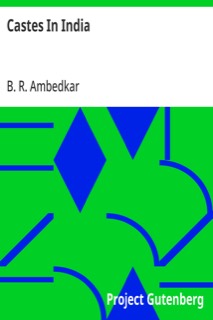
Castes in India

by B. R. Ambedkar

Length: 12,577 words, about 50 pages, about 53 minutes to read

Politics and society, History and travel

Read Castes in India free, starting with its best pages and lines below. Listen to it free too, read aloud by your phone's own voice.

The best passages

Pages from the book itself, chosen to make you want to read on. Each opens in the reader at that exact spot.

CASTES IN INDIA.

Many of us, I dare say, have witnessed local, national, or international expositions of material objects that make up the sum total of human civilization. But few can entertain the idea of there being such a thing as an exposition of human institutions. Exhibition of human institutions is a strange idea; some might call it the wildest of ideas. But as students of Ethnology I hope you will not be hard on this innovation, for it is not so, and to you at least it should not be strange.

You all have visited, I believe, some historic place like the ruins of Pompeii, and listened with curiosity to the history of the remains as it flowed from the glib tongue of the guide. In my opinion a student of Ethnology, in one sense at least, is much like the guide. Like his prototype, he holds up (perhaps with more seriousness and desire of self instruction) the social institutions to view, with all the objectiveness humanly possible, and inquires into their origin and function.

Keep reading from here

CASTES IN INDIA.

is in the consideration of the means utilized for the preservation of endogamy against exogamy that we may hope to find the solution of our problem.

Thus the superposition of endogamy on exogamy means the creation of Caste. But this is not an easy affair. Let us take an imaginary group that desires to make itself into a Caste and analyse what means it will have to adopt to make itself endogamous. If a group desires to make itself endogamous a formal injunction against intermarriage with outside groups will be of no avail, especially if prior to the introduction of endogamy, exogamy had been the rule in all matrimonial relations. Again, there is a tendency in all groups lying in close contact with one another to assimilate and amalgamate, and thus consolidate into a homogenous society. If this tendency is to be strongly counteracted in the interest of Caste formation, it is absolutely necessary to circumscribe a circle outside which people should not contract marriages.

Keep reading from here

CASTES IN INDIA.

Let us see what our imaginary group is likely to do with this surplus man and surplus woman. We will first take up the case of the surplus woman. She can be disposed of in two different ways so as to preserve the endogamy of the Caste.

First: burn her on the funeral pyre of her deceased husband and get rid of her. This, however, is rather an impracticable way of solving the problem of sex disparity. In some cases it may work, in others it may not. Consequently every surplus woman cannot thus be disposed of, because it is an easy solution but a hard realization. And so the surplus woman (= widow), if not disposed of, remains in the group: but in her very existence lies a double danger. She may marry outside the Caste and violate endogamy, or she may marry within the Caste and through competition encroach upon the chances of marriage that must be reserved for the potential brides in the Caste. She is therefore a menace in any case, and something must be done to her if she cannot be burned along with her deceased husband.

Keep reading from here

CASTES IN INDIA.

The problem of surplus man (= widower) is much more important and much more difficult than that of the surplus woman in a group that desires to make itself into a Caste. From time immemorial man as compared with woman has had the upper hand. He is a dominant figure in every group and of the two sexes has greater prestige. With this traditional superiority of man over woman his wishes have always been consulted. Woman, on the other hand, has been an easy prey to all kinds of iniquitous injunctions, religious, social or economic. But man as a maker of injunctions is most often above them all. Such being the case, you cannot accord the same kind of treatment to a surplus man as you can to a surplus woman in a Caste.

The project of burning him with his deceased wife is hazardous in two ways: first of all it cannot be done, simply because he is a man. Secondly, if done, a sturdy soul is lost to the Caste. There remain then only two solutions which can conveniently dispose of him. I say conveniently, because he is an asset to the group.

Keep reading from here

CASTES IN INDIA.

This sub-division of a society is quite natural. But the unnatural thing about these sub-divisions is that they have lost the open door character of the class system and have become self-enclosed units called castes. The question is, were they compelled to close their doors and become endogamous, or did they close them of their own accord? I submit that there is a double line of answer: Some closed the door: others found it closed against them. The one is a psychological interpretation and the other is mechanistic, but they are complementary and both are necessary to explain the phenomena of caste formation in its entirety.

I will first take up the psychological interpretation. The question we have to answer in this connection is: Why did these sub-divisions or classes, if you please, industrial, religious or otherwise, become self-enclosed or endogamous? My answer is because the Brahmans were so.

Keep reading from here

10 of the best lines

Exhibition of human institutions is a strange idea; some might call it the wildest of ideas.

CASTES IN INDIA.Keep reading from here

Woman, on the other hand, has been an easy prey to all kinds of iniquitous injunctions, religious, social or economic. But man as a maker of injunctions is most often above them all.

CASTES IN INDIA.Keep reading from here

Why compulsory widowhood is honoured I know not, nor have I yet met with any one who sang in praise of it, though there are a great many who adhere to it.

CASTES IN INDIA.Keep reading from here

You may pass a law that all cats are dogs, just as you can call a means an end.

CASTES IN INDIA.Keep reading from here

The question of origin is always an annoying question and in the study of Caste it is sadly neglected: some have connived at it, while others have dodged it.

CASTES IN INDIA.Keep reading from here

A caste is an enclosed class.

CASTES IN INDIA.Keep reading from here

Preaching did not make the caste system, neither will it unmake it.

CASTES IN INDIA.Keep reading from here

Imitation is easy and invention is difficult.

CASTES IN INDIA.Keep reading from here

A novel way of thinking will create a new Caste for the old ones will not tolerate it.

CASTES IN INDIA.Keep reading from here

Sentiment must be outlawed from the domain of science and things should be judged from an objective standpoint.

CASTES IN INDIA.Keep reading from here

All 20 Castes in India quotes, with the words around each

Reviews

No reviews yet. Be the first, in the app.

Write a review in Doomreader

Listen to Castes in India free

Castes in India as a free audiobook: Doomreader reads any book aloud, free, in your phone's or computer's own voice. Open the book and tap listen, at the speed you like, hands free.

Want a more natural voice? The AI voices read with AI credits.

Listen free in Doomreader

Download Castes in India free

The whole book as an EPUB file, free and legal, from Project Gutenberg. It opens in any ebook app, or read it here in Doomreader with nothing to install.

Download the EPUB (0.1 MB)

More like Castes in India

About this edition

Text from Project Gutenberg. In the public domain in the USA. The Project Gutenberg License is kept inside the file. Every passage and line on this page is the book's own words, checked against the text.