Doomreader

Bulfinch’s Mythology

by Thomas Bulfinch

Length: 330,616 words, about 1,322 pages, about 23 hours to read

Lives and letters

Read Bulfinch’s Mythology free, starting with its best pages and lines below. Listen to it free too, read aloud by your phone's own voice.

What it is

An American classicist collects and explains myths and legends ranging from those of the ancient Greeks and Romans, through stories of King Arthur, to the legends of Charlemagne.

The best passages

Pages from the book itself, chosen to make you want to read on. Each opens in the reader at that exact spot.

I: Introduction

The religions of ancient Greece and Rome are extinct. The so-called divinities of Olympus have not a single worshipper among living men. They belong now not to the department of theology, but to those of literature and taste. There they still hold their place, and will continue to hold it, for they are too closely connected with the finest productions of poetry and art, both ancient and modern, to pass into oblivion.

We propose to tell the stories relating to them which have come down to us from the ancients, and which are alluded to by modern poets, essayists, and orators. Our readers may thus at the same time be entertained by the most charming fictions which fancy has ever created, and put in possession of information indispensable to everyone who would read with intelligence the elegant literature of his own day.

In order to understand these stories, it will be necessary to acquaint ourselves with the ideas of the structure of the universe which prevailed among the Greeks⁠—the people from whom the Romans, and other nations through them, received their science and religion.

The Greeks believed the earth to be flat and circular, their own country occupying the middle of it, the central point being either Mount Olympus, the abode of the gods, or Delphi, so famous for its oracle.
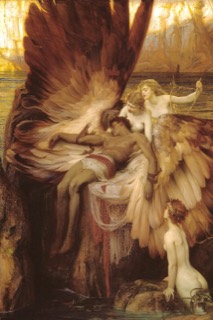
Keep reading from here

Apollo and Daphne

Daphne was Apollo’s first love. It was not brought about by accident, but by the malice of Cupid. Apollo saw the boy playing with his bow and arrows; and being himself elated with his recent victory over Python, he said to him, “What have you to do with warlike weapons, saucy boy? Leave them for hands worthy of them. Behold the conquest I have won by means of them over the vast serpent who stretched his poisonous body over acres of the plain! Be content with your torch, child, and kindle up your flames, as you call them, where you will, but presume not to meddle with my weapons.” Venus’s boy heard these words, and rejoined, “Your arrows may strike all things else, Apollo, but mine shall strike you.” So saying, he took his stand on a rock of Parnassus, and drew from his quiver two arrows of different workmanship, one to excite love, the other to repel it. The former was of gold and sharp pointed, the latter blunt and tipped with lead. With the leaden shaft he struck the nymph Daphne, the daughter of the river god Peneus, and with the golden one Apollo, through the heart. Forthwith the god was seized with love for the maiden, and she abhorred the thought of loving. Her delight was in woodland sports and in the spoils of the chase. Many lovers sought her, but she spurned them all, ranging the woods, and taking no thought of Cupid nor of Hymen.

Keep reading from here

VI: Midas—Baucis and Philemon

Bacchus, on a certain occasion, found his old schoolmaster and foster-father, Silenus, missing. The old man had been drinking, and in that state wandered away, and was found by some peasants, who carried him to their king, Midas. Midas recognized him, and treated him hospitably, entertaining him for ten days and nights with an unceasing round of jollity. On the eleventh day he brought Silenus back, and restored him in safety to his pupil. Whereupon Bacchus offered Midas his choice of a reward, whatever he might wish. He asked that whatever he might touch should be changed into gold. Bacchus consented, though sorry that he had not made a better choice. Midas went his way, rejoicing in his new-acquired power, which he hastened to put to the test. He could scarce believe his eyes when he found a twig of an oak, which he plucked from the branch, become gold in his hand. He took up a stone; it changed to gold. He touched a sod; it did the same. He took an apple from the tree; you would have thought he had robbed the garden of the Hesperides. His joy knew no bounds, and as soon as he got home, he ordered the servants to set a splendid repast on the table. Then he found to his dismay that whether he touched bread, it hardened in his hand; or put a morsel to his lips, it defied his teeth. He took a glass of wine, but it flowed down his throat like melted gold.

Keep reading from here

XI: Cupid and Psyche

A certain king and queen had three daughters. The charms of the two elder were more than common, but the beauty of the youngest was so wonderful that the poverty of language is unable to express its due praise. The fame of her beauty was so great that strangers from neighboring countries came in crowds to enjoy the sight, and looked on her with amazement, paying her that homage which is due only to Venus herself. In fact Venus found her altars deserted, while men turned their devotion to this young virgin. As she passed along, the people sang her praises, and strewed her way with chaplets and flowers.

This perversion of homage due only to the immortal powers to the exaltation of a mortal gave great offence to the real Venus. Shaking her ambrosial locks with indignation, she exclaimed, “Am I then to be eclipsed in my honors by a mortal girl? In vain then did that royal shepherd, whose judgment was approved by Jove himself, give me the palm of beauty over my illustrious rivals, Pallas and Juno. But she shall not so quietly usurp my honors. I will give her cause to repent of so unlawful a beauty.”

Thereupon she calls her winged son Cupid, mischievous enough in his own nature, and rouses and provokes him yet more by her complaints. She points out Psyche to him and says, “My dear son, punish that contumacious beauty; give thy mother a revenge as sweet as her injuries are great; infuse into the bosom of that haughty girl a passion for some low, mean, unworthy being, so that she may reap a mortification as great as her present exultation and triumph.”

Keep reading from here

Thor’s Visit to Jotunheim, the Giant’s Country

One day the god Thor, with his servant Thialfi, and accompanied by Loki, set out on a journey to the giant’s country. Thialfi was of all men the swiftest of foot. He bore Thor’s wallet, containing their provisions. When night came on they found themselves in an immense forest, and searched on all sides for a place where they might pass the night, and at last came to a very large hall, with an entrance that took the whole breadth of one end of the building. Here they lay down to sleep, but towards midnight were alarmed by an earthquake which shook the whole edifice. Thor, rising up, called on his companions to seek with him a place of safety. On the right they found an adjoining chamber, into which the others entered, but Thor remained at the doorway with his mallet in his hand, prepared to defend himself, whatever might happen. A terrible groaning was heard during the night, and at dawn of day Thor went out and found lying near him a huge giant, who slept and snored in the way that had alarmed them so. It is said that for once Thor was afraid to use his mallet, and as the giant soon waked up, Thor contented himself with simply asking his name.

Keep reading from here

10 of the best lines

For mythology is the handmaid of literature; and literature is one of the best allies of virtue and promoters of happiness.

Author’s PrefaceKeep reading from here

Silence reigns there; but from the bottom of the rock the River Lethe flows, and by its murmur invites to sleep.

IX: Ceyx and Halcyone: or, the Halcyon BirdsKeep reading from here

He kissed the boy, not knowing that it was for the last time.

DaedalusKeep reading from here

The descent to Avernus is easy: the gate of Pluto stands open night and day; but to retrace one’s steps and return to the upper air, that is the toil, that the difficulty.

PalinurusKeep reading from here

Thy wrestling with Elli was also a most astonishing feat, for there was never yet a man, nor ever will be, whom Old Age, for such in fact was Elli, will not sooner or later lay low.

Thor’s Visit to Jotunheim, the Giant’s CountryKeep reading from here

“I have seen,” said he, “great marvels that no tongue can tell, and more than any heart can think.”

Sir Launcelot (Resumed)Keep reading from here

“He will profit him more than the weir ever profited thee.”

XIII: TaliesinKeep reading from here

I have lived an evil life, but need not be rebellious to God in death also.

The Siege of AlbraccaKeep reading from here

Let no one suppose we speak here of kingdoms or of treasures; they are the toys of Fortune, which she dispenses in turning her wheel; we speak of things which she can neither give nor take away.

Astolpho in AbyssiniaKeep reading from here

Time flew by, leaving no impression of its flight.

Ogier, the Dane (Continued)Keep reading from here

All 192 Bulfinch’s Mythology quotes, with the words around each

Reviews

No reviews yet. Be the first, in the app.

Write a review in Doomreader

Contents

All 335 parts
  1. Publishers’ Preface
  2. Author’s Preface
  3. Stories of Gods and Heroes
  4. I: Introduction
  5. Roman Divinities
  6. II: Prometheus and Pandora
  7. III: Apollo and Daphne—Pyramus and Thisbe—Cephalus and Procris
  8. Apollo and Daphne
  9. Pyramus and Thisbe
  10. Cephalus and Procris
  11. IV: Juno and Her Rivals, Io and Callisto—Diana and Actaeon—Latona and the Rustics
  12. Callisto
  13. Diana and Actaeon
  14. Latona and the Rustics
  15. V: Phaëton
  16. VI: Midas—Baucis and Philemon
  17. Baucis and Philemon
  18. VII: Proserpine—Glaucus and Scylla
  19. Glaucus and Scylla
  20. VIII: Pygmalion—Dryope—Venus and Adonis—Apollo and Hyacinthus
  21. Dryope
  22. Venus and Adonis
  23. Apollo and Hyacinthus
  24. IX: Ceyx and Halcyone: or, the Halcyon Birds
  25. X: Vertumnus and Pomona
  26. XI: Cupid and Psyche
  27. XII: Cadmus—The Myrmidons
  28. The Myrmidons
  29. XIII: Nisus and Scylla—Echo and Narcissus—Clytie—Hero and Leander
  30. Nisus and Scylla
  31. Echo and Narcissus
  32. Clytie
  33. Hero and Leander
  34. XIV: Minerva—Niobe
  35. Minerva
  36. Niobe
  37. XV: The Graeae or Gray-Maids—Perseus—Medusa—Atlas—Andromeda
  38. The Graeae and the Gorgons
  39. Perseus and Medusa
  40. Perseus and Atlas
  41. The Sea-Monster
  42. The Wedding Feast
  43. XVI: Monsters
  44. Giants, Sphinx, Pegasus and Chimaera, Centaurs, Griffin, and Pygmies
  45. The Sphinx
  46. Pegasus and the Chimaera
  47. The Centaurs
  48. The Pygmies
  49. The Griffin, or Gryphon
  50. XVII: The Golden Fleece—Medea
  51. The Golden Fleece
  52. Medea and Aeson
  53. XVIII: Meleager and Atalanta
  54. Atalanta
  55. XIX: Hercules—Hebe and Ganymede
  56. Hercules
  57. Hebe and Ganymede
  58. XX: Theseus—Daedalus—Castor and Pollux
  59. Theseus
  60. Olympic and Other Games
  61. Daedalus
  62. Castor and Pollux
  63. XXI: Bacchus—Ariadne
  64. Bacchus
  65. Ariadne
  66. XXII: The Rural Deities—Erisichthon—Rhoecus—The Water Deities—Camenae—Winds
  67. The Rural Deities
  68. Erisichthon
  69. Rhoecus
  70. The Water Deities
  71. Neptune
  72. Amphitrite
  73. Nereus and Doris
  74. Triton and Proteus
  75. Thetis
  76. Leucothea and Palaemon
  77. The Camenae
  78. The Winds
  79. XXIII: Achelous and Hercules—Admetus and Alcestis—Antigone—Penelope
  80. Achelous and Hercules
  81. Admetus and Alcestis
  82. Antigone
  83. Penelope
  84. XXIV: Orpheus and Eurydice—Aristaeus—Amphion—Linus—Thamyris—Marsyas—Melampus—Musaeus
  85. Orpheus and Eurydice
  86. Aristaeus, the Beekeeper
  87. Amphion
  88. Linus
  89. Thamyris
  90. Marsyas
  91. Melampus
  92. Musaeus
  93. XXV: Arion—Ibycus—Simonides—Sappho
  94. Arion
  95. Ibycus
  96. Simonides
  97. Sappho
  98. XXVI: Endymion—Orion—Aurora and Tithonus—Acis and Galatea
  99. Diana and Endymion
  100. Orion
  101. Aurora and Tithonus
  102. Acis and Galatea
  103. XXVII: The Trojan War
  104. The Iliad
  105. XXVIII: The Fall of Troy—Return of the Greeks—Orestes and Electra
  106. The Fall of Troy
  107. Menelaus and Helen
  108. Agamemnon, Orestes, and Electra
  109. Troy
  110. XXIX: Adventures of Ulysses—The Lotus-Eaters—Cyclopes—Circe—Sirens—Scylla and Charybdis—Calypso
  111. Return of Ulysses
  112. The Laestrygonians
  113. Scylla and Charybdis
  114. Calypso
  115. XXX: The Phaeacians—Fate of the Suitors
  116. The Phaeacians
  117. Fate of the Suitors
  118. XXXI: Adventures of Aeneas—The Harpies—Dido—Palinurus
  119. Adventures of Aeneas
  120. Dido
  121. Palinurus
  122. XXXII: The Infernal Regions—The Sibyl
  123. The Infernal Regions
  124. Elysium
  125. The Sibyl
  126. XXXIII: Camilla—Evander—Nisus and Euryalus—Mezentius—Turnus
  127. Opening the Gates of Janus
  128. Camilla
  129. Evander
  130. Infant Rome
  131. Nisus and Euryalus
  132. Mezentius
  133. Pallas, Camilla, Turnus
  134. XXXIV: Pythagoras—Egyptian Deities—Oracles
  135. Pythagoras
  136. Sybaris and Crotona
  137. Egyptian Deities
  138. Myth of Osiris and Isis
  139. Oracles
  140. Oracle of Trophonius
  141. Oracle of Aesculapius
  142. Oracle of Apis
  143. XXXV: Origin of Mythology—Statues of Gods and Goddesses—Poets of Mythology
  144. Origin of Mythology
  145. Statues of the Gods
  146. The Olympian Jupiter
  147. The Minerva of the Parthenon
  148. The Venus de Medici
  149. The Apollo Belvedere
  150. The Diana a la Biche
  151. The Poets of Mythology
  152. Virgil
  153. Ovid
  154. XXXVI: Modern Monsters—The Phoenix—Basilisk—Unicorn—Salamander
  155. Modern Monsters
  156. The Phoenix
  157. The Cockatrice, or Basilisk
  158. The Unicorn
  159. The Salamander
  160. XXXVII: Eastern Mythology—Zoroaster—Hindu Mythology—Castes—Buddha—Grand Lama
  161. Zoroaster
  162. Hindu Mythology
  163. Vishnu
  164. Siva
  165. Juggernaut
  166. Castes
  167. Buddha
  168. The Grand Lama
  169. Prester John
  170. XXXVIII: Northern Mythology—Valhalla—The Valkyrior
  171. Northern Mythology
  172. Of the Joys of Valhalla
  173. The Valkyrie
  174. Of Thor and the Other Gods
  175. Of Loki and His Progeny
  176. How Thor Paid the Mountain Giant His Wages
  177. The Recovery of the Hammer
  178. XXXIX: Thor’s Visit to Jotunheim
  179. Thor’s Visit to Jotunheim, the Giant’s Country
  180. XL: The Death of Baldur—The Elves—Runic Letters—Iceland—Teutonic Mythology—Nibelungen Lied
  181. The Death of Baldur
  182. The Funeral of Baldur
  183. The Elves
  184. Ragnarok, the Twilight of the Gods
  185. Runic Letters
  186. The Skalds
  187. Iceland
  188. Teutonic Mythology
  189. The Nibelungen Lied
  190. The Nibelungen Hoard
  191. Wagner’s Nibelungen Ring
  192. XLI: The Druids—Iona
  193. Druids
  194. Iona
  195. King Arthur and His Knights
  196. I: Introduction
  197. The Training of a Knight
  198. Freemen, Villains, Serfs, and Clerks
  199. Tournaments
  200. Mail Armor
  201. Helmets
  202. Romances
  203. Metrical Romances
  204. II: The Mythical History of England
  205. Bladud
  206. Leir
  207. Ferrex and Porrex
  208. Dunwallo Molmutius
  209. Brennus and Belinus
  210. Elidure
  211. Lud
  212. Cassibellaunus
  213. Kymbelinus, or Cymbeline
  214. Armorica
  215. III: Merlin
  216. IV: Arthur
  217. King Arthur
  218. Arthur Chosen King
  219. Guenever
  220. V: Arthur (Continued)
  221. King Arthur Slays the Giant of St. Michael’s Mount
  222. King Arthur Gets a Sword from the Lady of the Lake
  223. VI: Sir Gawain
  224. Sir Gawain’s Marriage
  225. VII: Caradoc Briefbras; or, Caradoc with the Shrunken Arm
  226. VIII: Launcelot of the Lake
  227. Sir Launcelot
  228. IX: The Adventure of the Cart
  229. X: The Lady of Shalott
  230. XI: Queen Guenever’s Peril
  231. XII: Tristram and Isoude
  232. XIII: Tristram and Isoude (Continued)
  233. XIV: Sir Tristram’s Battle with Sir Launcelot
  234. Sir Tristram as a Sportsman
  235. XV: The Round Table
  236. XVI: Sir Palamedes
  237. XVII: Sir Tristram
  238. XVIII: Perceval
  239. XIX: The Sangreal, or Holy Graal
  240. Sir Galahad
  241. Sir Gawain
  242. XX: The Sangreal (Continued)
  243. Sir Launcelot
  244. Sir Perceval
  245. XXI: The Sangreal (Continued)
  246. Sir Bohort
  247. Sir Launcelot (Resumed)
  248. Sir Galahad
  249. XXII: Sir Agrivain’s Treason
  250. XXIII: Morte d’Arthur
  251. The Mabinogeon
  252. Introductory Note
  253. I: The Britons
  254. The Welsh Language and Literature
  255. The Welsh Bards
  256. The Triads
  257. II: The Lady of the Fountain
  258. Kynon’s Adventure
  259. III: The Lady of the Fountain (Continued)
  260. Owain’s Adventure
  261. IV: The Lady of the Fountain (Continued)
  262. Gawain’s Adventure
  263. The Adventure of the Lion
  264. V: Geraint, the Son of Erbin
  265. VI: Geraint, the Son of Erbin (Continued)
  266. VII: Geraint, the Son of Erbin (Continued)
  267. VIII: Pwyll, Prince of Dyved
  268. IX: Branwen, the Daughter of Llyr
  269. X: Manawyddan
  270. XI: Kilwich and Olwen
  271. XII: Kilwich and Olwen (Continued)
  272. XIII: Taliesin
  273. Hero Myths of the British Isles
  274. Beowulf
  275. Cuchulain, Champion of Ireland
  276. Hereward the Wake
  277. Robin Hood
  278. Legends of Charlemagne
  279. Introduction
  280. The Peers, or Paladins
  281. Orlando
  282. Roland and Ferragus
  283. A Roland for an Oliver
  284. Rinaldo
  285. The Tournament
  286. The Siege of Albracca
  287. Adventures of Rinaldo and Orlando
  288. The Invasion of France
  289. The Invasion of France (Continued)
  290. Bradamante and Rogero
  291. Astolpho and the Enchantress
  292. The Orc
  293. Astolpho’s Adventures Continued, and Isabella’s Begun
  294. Medoro
  295. Orlando Mad
  296. Zerbino and Isabella
  297. Astolpho in Abyssinia
  298. The War in Africa
  299. Rogero and Bradamante
  300. The Battle of Roncesvalles
  301. Rinaldo and Bayard
  302. Death of Rinaldo
  303. Huon of Bordeaux
  304. Huon of Bordeaux (Continued)
  305. Huon of Bordeaux (Continued)
  306. Ogier, the Dane
  307. Ogier, the Dane (Continued)
  308. Ogier, the Dane (Continued)
  309. Glossary
  310. A
  311. B
  312. Chapter C
  313. Chapter D
  314. E
  315. F
  316. G
  317. H
  318. Chapter I
  319. J
  320. K
  321. Chapter L
  322. Chapter M
  323. N
  324. O
  325. P
  326. Q
  327. R
  328. S
  329. T
  330. U
  331. Chapter V
  332. W
  333. Chapter X
  334. Y
  335. Z

Listen to Bulfinch’s Mythology free

Bulfinch’s Mythology as a free audiobook: Doomreader reads any book aloud, free, in your phone's or computer's own voice. Open the book and tap listen, at the speed you like, hands free.

Want a more natural voice? The AI voices read with AI credits.

Listen free in Doomreader

Download Bulfinch’s Mythology free

The whole book as an EPUB file, free and legal, from Standard Ebooks. It opens in any ebook app, or read it here in Doomreader with nothing to install.

Download the EPUB (2.4 MB)

More like Bulfinch’s Mythology

About this edition

Text from Standard Ebooks. Standard Ebooks dedicate their edition to the public domain (CC0 1.0). Every passage and line on this page is the book's own words, checked against the text.