Doomreader

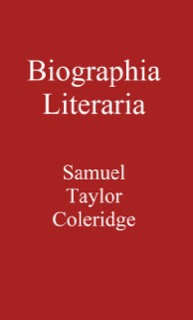
Biographia Literaria

by Samuel Taylor Coleridge

Length: 141,523 words, about 566 pages, about 10 hours to read

Lives and letters, Essays and ideas

Read Biographia Literaria free, starting with its best pages and lines below. Listen to it free too, read aloud by your phone's own voice.

The best passages

Pages from the book itself, chosen to make you want to read on. Each opens in the reader at that exact spot.

CHAPTER I

At school, (Christ’s Hospital,) I enjoyed the inestimable advantage of a very sensible, though at the same time, a very severe master, the Reverend James Bowyer. He early moulded my taste to the preference of Demosthenes to Cicero, of Homer and Theocritus to Virgil, and again of Virgil to Ovid. He habituated me to compare Lucretius, (in such extracts as I then read,) Terence, and above all the chaster poems of Catullus, not only with the Roman poets of the, so called, silver and brazen ages; but with even those of the Augustan aera: and on grounds of plain sense and universal logic to see and assert the superiority of the former in the truth and nativeness both of their thoughts and diction. At the same time that we were studying the Greek tragic poets, he made us read Shakespeare and Milton as lessons: and they were the lessons too, which required most time and trouble to bring up, so as to escape his censure. I learned from him, that poetry, even that of the loftiest and, seemingly, that of the wildest odes, had a logic of its own, as severe as that of science; and more difficult, because more subtle, more complex, and dependent on more, and more fugitive causes. In the truly great poets, he would say, there is a reason assignable, not only for every word, but for the position of every word; and I well remember that, availing himself of the synonymes to
Keep reading from here

CHAPTER I

From causes, which this is not the place to investigate, no models of past times, however perfect, can have the same vivid effect on the youthful mind, as the productions of contemporary genius. The discipline, my mind had undergone, Ne falleretur rotundo sono et versuum cursu, cincinnis, et floribus; sed ut inspiceret quidnam subesset, quae, sedes, quod firmamentum, quis fundus verbis; an figures essent mera ornatura et orationis fucus; vel sanguinis e materiae ipsius corde effluentis rubor quidam nativus et incalescentia genuina;—removed all obstacles to the appreciation of excellence in style without diminishing my delight. That I was thus prepared for the perusal of Mr. Bowles’s sonnets and earlier poems, at once increased their influence, and my enthusiasm. The great works of past ages seem to a young man things of another race, in respect to which his faculties must remain passive and submiss, even as to the stars and mountains. But the writings of a contemporary, perhaps not many years older than himself, surrounded by the same circumstances, and disciplined by the same manners, possess a reality for him, and inspire an actual friendship as of a man for a man. His very admiration is the wind which fans and feeds his hope. The poems themselves assume the properties of flesh and blood. To recite, to extol, to contend for them is but the payment of a debt due to one, who exists to receive it.

Keep reading from here

CHAPTER X

In confirmation of my first caveat, I will select one fact among many. On my list of subscribers, among a considerable number of names equally flattering, was that of an Earl of Cork, with his address. He might as well have been an Earl of Bottle, for aught I knew of him, who had been content to reverence the peerage in abstracto, rather than in concretis. Of course THE FRIEND was regularly sent as far, if I remember right, as the eighteenth number; that is, till a fortnight before the subscription was to be paid. And lo! just at this time I received a letter from his Lordship, reproving me in language far more lordly than courteous for my impudence in directing my pamphlets to him, who knew nothing of me or my work! Seventeen or eighteen numbers of which, however, his Lordship was pleased to retain, probably for the culinary or post-culinary conveniences of his servants.

Keep reading from here

CHAPTER X

A learned and exemplary old clergyman, who many years ago went to his reward followed by the regrets and blessings of his flock, published at his own expense two volumes octavo, entitled, A NEW THEORY OF REDEMPTION. The work was most severely handled in THE MONTHLY or CRITICAL REVIEW, I forget which; and this unprovoked hostility became the good old man’s favourite topic of conversation among his friends. “Well!” (he used to exclaim,) “in the second edition, I shall have an opportunity of exposing both the ignorance and the malignity of the anonymous critic.” Two or three years however passed by without any tidings from the bookseller, who had undertaken the printing and publication of the work, and who was perfectly at his ease, as the author was known to be a man of large property. At length the accounts were written for; and in the course of a few weeks they were presented by the rider for the house, in person. My old friend put on his spectacles, and holding the scroll with no very firm hand, began—“Paper, so much: O moderate enough—not at all beyond my expectation! Printing, so much: well! moderate enough! Stitching, covers, advertisements, carriage, and so forth, so much.”—Still nothing amiss. Selleridge (for orthography is no necessary part of a bookseller’s literary acquirements) L3. 3s. “Bless me! only three guineas for the what d’ye call it—the selleridge?” “No more, Sir!” replied the rider. “Nay, but that is too moderate!” rejoined my old friend. “Only three guineas for selling a thousand copies of a work in two volumes?” “O Sir!” (cries the young traveller) “you have mistaken the word. There have been none of them sold; they have been sent back from London long ago; and this L3.

Keep reading from here

CHAPTER XII

A chapter of requests and premonitions concerning the perusal or omission of the chapter that follows.

In the perusal of philosophical works I have been greatly benefited by a resolve, which, in the antithetic form and with the allowed quaintness of an adage or maxim, I have been accustomed to word thus: until you understand a writer’s ignorance, presume yourself ignorant of his understanding. This golden rule of mine does, I own, resemble those of Pythagoras in its obscurity rather than in its depth. If however the reader will permit me to be my own Hierocles, I trust, that he will find its meaning fully explained by the following instances. I have now before me a treatise of a religious fanatic, full of dreams and supernatural experiences. I see clearly the writer’s grounds, and their hollowness. I have a complete insight into the causes, which through the medium of his body has acted on his mind; and by application of received and ascertained laws I can satisfactorily explain to my own reason all the strange incidents, which the writer records of himself. And this I can do without suspecting him of any intentional falsehood. As when in broad day-light a man tracks the steps of a traveller, who had lost his way in a fog or by a treacherous moonshine, even so, and with the same tranquil sense of certainty, can I follow the traces of this bewildered visionary. I understand his ignorance.

On the other hand, I have been re-perusing with the best energies of my mind the TIMAEUS of Plato.

Keep reading from here

10 of the best lines

His very admiration is the wind which fans and feeds his hope.

CHAPTER IKeep reading from here

In all perplexity there is a portion of fear, which predisposes the mind to anger.

CHAPTER IVKeep reading from here

By few only can a large remuneration be expected; but fifty pounds and ease of mind are of more real advantage to a literary man, than the chance of five hundred with the certainty of insult and degrading anxieties.

CHAPTER XKeep reading from here

Time spent in such delay is time won: for manhood in the meantime is advancing, and with it increase of knowledge, strength of judgment, and above all, temperance of feelings.

CHAPTER XIKeep reading from here

To such a man philosophy is a mere play of words and notions, like a theory of music to the deaf, or like the geometry of light to the blind.

CHAPTER XIIKeep reading from here

The reader should be carried forward, not merely or chiefly by the mechanical impulse of curiosity, or by a restless desire to arrive at the final solution; but by the pleasureable activity of mind excited by the attractions of the journey itself.

CHAPTER XIVKeep reading from here

Every man’s language varies, according to the extent of his knowledge, the activity of his faculties, and the depth or quickness of his feelings.

CHAPTER XVIIKeep reading from here

Amid all his droll looks and droll gestures, there remained one look untouched by laughter; and that one look was the true face, the others were but its mask.

SATYRANE’S LETTERSKeep reading from here

O we are querulous creatures! Little less Than all things can suffice to make us happy: And little more than nothing is enough To make us wretched.

CONCLUSIONKeep reading from here

Pantheism is therefore not necessarily irreligious or heretical; though it may be taught atheistically.

FOOTNOTESKeep reading from here

All 88 Biographia Literaria quotes, with the words around each

Reviews

No reviews yet. Be the first, in the app.

Write a review in Doomreader

Contents

All 28 parts
  1. LIST OF CONTENTS
  2. CHAPTER I
  3. CHAPTER II
  4. CHAPTER III
  5. CHAPTER IV
  6. CHAPTER V
  7. CHAPTER VI
  8. CHAPTER VII
  9. CHAPTER VIII
  10. CHAPTER IX
  11. CHAPTER X
  12. CHAPTER XI
  13. CHAPTER XII
  14. CHAPTER XIII
  15. CHAPTER XIV
  16. CHAPTER XV
  17. CHAPTER XVI
  18. CHAPTER XVII
  19. CHAPTER XVIII
  20. CHAPTER XIX
  21. CHAPTER XX
  22. CHAPTER XXI
  23. CHAPTER XXII
  24. SATYRANE’S LETTERS
  25. CHAPTER XXIII
  26. CHAPTER XXIV
  27. CONCLUSION
  28. FOOTNOTES

Listen to Biographia Literaria free

Biographia Literaria as a free audiobook: Doomreader reads any book aloud, free, in your phone's or computer's own voice. Open the book and tap listen, at the speed you like, hands free.

Want a more natural voice? The AI voices read with AI credits.

Listen free in Doomreader

Download Biographia Literaria free

The whole book as an EPUB file, free and legal, from Project Gutenberg. It opens in any ebook app, or read it here in Doomreader with nothing to install.

Download the EPUB (0.5 MB)

More like Biographia Literaria

About this edition

Text from Project Gutenberg. In the public domain in the USA. The Project Gutenberg License is kept inside the file. Every passage and line on this page is the book's own words, checked against the text.