Doomreader

Antony and Cleopatra

by William Shakespeare

Length: 27,024 words, about 108 pages, about 2 hours to read

Drama

Read Antony and Cleopatra free, starting with its best pages and lines below. Listen to it free too, read aloud by your phone's own voice.

What it is

Mark Antony, a Roman triumvir, and Cleopatra, the Queen of Egypt, become embroiled in a deadly love affair.

The best passages

Pages from the book itself, chosen to make you want to read on. Each opens in the reader at that exact spot.

Act I, Scene I

Nay, but this dotage of our general’s O’erflows the measure: those his goodly eyes, That o’er the files and musters of the war Have glow’d like plated Mars, now bend, now turn, The office and devotion of their view Upon a tawny front: his captain’s heart, Which in the scuffles of great fights hath burst The buckles on his breast, reneges all temper, And is become the bellows and the fan To cool a gipsy’s lust.

Flourish. Enter Antony, Cleopatra, her Ladies, the Train, with Eunuchs fanning her.

Look, where they come: Take but good note, and you shall see in him. The triple pillar of the world transform’d Into a strumpet’s fool: behold and see.

Cleopatra

If it be love indeed, tell me how much.

Antony

There’s beggary in the love that can be reckon’d.

Cleopatra

I’ll set a bourn how far to be beloved.

Antony

Then must thou needs find out new heaven, new earth.

Enter an Attendant.

Attendant

News, my good lord, from Rome.

Antony

Grates me: the sum.

Cleopatra

Nay, hear them, Antony: Fulvia perchance is angry; or, who knows If the scarce-bearded Caesar have not sent His powerful mandate to you, “Do this, or this; Take in that kingdom, and enfranchise that; Perform’t, or else we damn thee.”

Antony

How, my love!

Cleopatra

Perchance! nay, and most like: You must not stay here longer, your dismission Is come from Caesar; therefore hear it, Antony. Where’s Fulvia’s process? Caesar’s I would say? both? Call in the messengers. As I am Egypt’s queen, Thou blushest, Antony; and that blood of thine Is Caesar’s homager: else so thy cheek pays shame When shrill-tongued Fulvia scolds.

Keep reading from here

Act I, Scene II

Antony

I must with haste from hence.

Enobarbas

Why, then, we kill all our women: we see how mortal an unkindness is to them; if they suffer our departure, death’s the word.

Antony

I must be gone.

Enobarbas

Under a compelling occasion, let women die: it were pity to cast them away for nothing; though, between them and a great cause, they should be esteemed nothing. Cleopatra, catching but the least noise of this, dies instantly; I have seen her die twenty times upon far poorer moment: I do think there is mettle in death, which commits some loving act upon her, she hath such a celerity in dying.

Antony

She is cunning past man’s thought.

Enobarbas

Alack, sir, no; her passions are made of nothing but the finest part of pure love: we cannot call her winds and waters sighs and tears; they are greater storms and tempests than almanacs can report: this cannot be cunning in her; if it be, she makes a shower of rain as well as Jove.

Antony

Would I had never seen her!

Enobarbas

O, sir, you had then left unseen a wonderful piece of work; which not to have been blest withal would have discredited your travel.

Antony

Fulvia is dead.

Enobarbas

Sir?

Antony

Fulvia is dead.

Enobarbas

Fulvia!

Antony

Dead.

Enobarbas

Why, sir, give the gods a thankful sacrifice. When it pleaseth their deities to take the wife of a man from him, it shows to man the tailors of the earth; comforting therein, that when old robes are worn out, there are members to make new.

Keep reading from here

Act I, Scene III

Antony

Now, my dearest queen⁠—

Cleopatra

Pray you, stand farther from me.

Antony

What’s the matter?

Cleopatra

I know, by that same eye, there’s some good news. What says the married woman? You may go: Would she had never given you leave to come! Let her not say ’tis I that keep you here: I have no power upon you; hers you are.

Antony

The gods best know⁠—

Cleopatra

O, never was there queen So mightily betray’d! yet at the first I saw the treasons planted.

Antony

Cleopatra⁠—

Cleopatra

Why should I think you can be mine and true, Though you in swearing shake the throned gods, Who have been false to Fulvia? Riotous madness, To be entangled with those mouth-made vows, Which break themselves in swearing!

Antony

Most sweet queen⁠—

Cleopatra

Nay, pray you, seek no colour for your going, But bid farewell, and go: when you sued staying, Then was the time for words: no going then; Eternity was in our lips and eyes, Bliss in our brows’ bent; none our parts so poor, But was a race of heaven: they are so still, Or thou, the greatest soldier of the world, Art turn’d the greatest liar.

Keep reading from here

Act II, Scene II

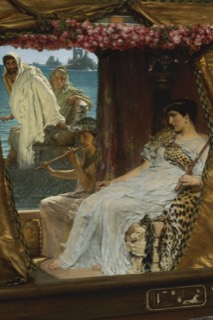
I will tell you. The barge she sat in, like a burnish’d throne, Burn’d on the water: the poop was beaten gold; Purple the sails, and so perfumed that The winds were love-sick with them; the oars were silver, Which to the tune of flutes kept stroke, and made The water which they beat to follow faster, As amorous of their strokes. For her own person, It beggar’d all description: she did lie In her pavilion⁠—cloth-of-gold of tissue⁠— O’er-picturing that Venus where we see The fancy outwork nature: on each side her Stood pretty dimpled boys, like smiling Cupids, With divers-colour’d fans, whose wind did seem To glow the delicate cheeks which they did cool, And what they undid did.

Agrippa

O, rare for Antony!

Enobarbas

Her gentlewomen, like the Nereides, So many mermaids, tended her i’ the eyes, And made their bends adornings: at the helm A seeming mermaid steers: the silken tackle Swell with the touches of those flower-soft hands, That yarely frame the office. From the barge A strange invisible perfume hits the sense Of the adjacent wharfs. The city cast Her people out upon her; and Antony, Enthroned i’ the market-place, did sit alone, Whistling to the air; which, but for vacancy, Had gone to gaze on Cleopatra too, And made a gap in nature.

Keep reading from here

Act II, Scene V

Messenger

First, madam, he is well.

Cleopatra

Why, there’s more gold. But, sirrah, mark, we use To say the dead are well: bring it to that, The gold I give thee will I melt and pour Down thy ill-uttering throat.

Messenger

Good madam, hear me.

Cleopatra

Well, go to, I will; But there’s no goodness in thy face: if Antony Be free and healthful⁠—so tart a favour To trumpet such good tidings! If not well, Thou shouldst come like a Fury crown’d with snakes, Not like a formal man.

Messenger

Will’t please you hear me?

Cleopatra

I have a mind to strike thee ere thou speak’st: Yet if thou say Antony lives, is well, Or friends with Caesar, or not captive to him, I’ll set thee in a shower of gold, and hail Rich pearls upon thee.

Messenger

Madam, he’s well.

Cleopatra

Well said.

Messenger

And friends with Caesar.

Cleopatra

Thou’rt an honest man.

Messenger

Caesar and he are greater friends than ever.

Cleopatra

Make thee a fortune from me.

Messenger

But yet, madam⁠—

Cleopatra

I do not like “But yet,” it does allay The good precedence; fie upon “But yet”! “But yet” is as a gaoler to bring forth Some monstrous malefactor. Prithee, friend, Pour out the pack of matter to mine ear, The good and bad together: he’s friends with Caesar; In state of health thou say’st; and thou say’st free.

Keep reading from here

10 of the best lines

There’s beggary in the love that can be reckon’d.

Act I, Scene IKeep reading from here

Eternity was in our lips and eyes,

Act I, Scene IIIKeep reading from here

Burn’d on the water: the poop was beaten gold;

Act II, Scene IIKeep reading from here

I do not like “But yet,” it does allay

Act II, Scene VKeep reading from here

Than by the negligent.

Act III, Scene VIIKeep reading from here

’Tis better playing with a lion’s whelp

Act III, Scene XIIIKeep reading from here

Eros, thou yet behold’st me?

Act IV, Scene XIVKeep reading from here

Of many thousand kisses the poor last

Act IV, Scene XVKeep reading from here

His legs bestrid the ocean: his rear’d arm

Act V, Scene IIKeep reading from here

Make not your thoughts your prisons

Act V, Scene IIKeep reading from here

All 53 Antony and Cleopatra quotes, with the words around each

Reviews

No reviews yet. Be the first, in the app.

Write a review in Doomreader

Contents

All 42 parts
  1. Act I, Scene I
  2. Act I, Scene II
  3. Act I, Scene III
  4. Act I, Scene IV
  5. Act I, Scene V
  6. Act II, Scene I
  7. Act II, Scene II
  8. Act II, Scene III
  9. Act II, Scene IV
  10. Act II, Scene V
  11. Act II, Scene VI
  12. Act II, Scene VII
  13. Act III, Scene I
  14. Act III, Scene II
  15. Act III, Scene III
  16. Act III, Scene IV
  17. Act III, Scene V
  18. Act III, Scene VI
  19. Act III, Scene VII
  20. Act III, Scene VIII
  21. Act III, Scene IX
  22. Act III, Scene X
  23. Act III, Scene XI
  24. Act III, Scene XII
  25. Act III, Scene XIII
  26. Act IV, Scene I
  27. Act IV, Scene II
  28. Act IV, Scene III
  29. Act IV, Scene IV
  30. Act IV, Scene V
  31. Act IV, Scene VI
  32. Act IV, Scene VII
  33. Act IV, Scene VIII
  34. Act IV, Scene IX
  35. Act IV, Scene X
  36. Act IV, Scene XI
  37. Act IV, Scene XII
  38. Act IV, Scene XIII
  39. Act IV, Scene XIV
  40. Act IV, Scene XV
  41. Act V, Scene I
  42. Act V, Scene II

Listen to Antony and Cleopatra free

Antony and Cleopatra as a free audiobook: Doomreader reads any book aloud, free, in your phone's or computer's own voice. Open the book and tap listen, at the speed you like, hands free.

Want a more natural voice? The AI voices read with AI credits.

Listen free in Doomreader

Download Antony and Cleopatra free

The whole book as an EPUB file, free and legal, from Standard Ebooks. It opens in any ebook app, or read it here in Doomreader with nothing to install.

Download the EPUB (1.0 MB)

More by William Shakespeare

More like Antony and Cleopatra

About this edition

Text from Standard Ebooks. Standard Ebooks dedicate their edition to the public domain (CC0 1.0). Every passage and line on this page is the book's own words, checked against the text.