Doomreader

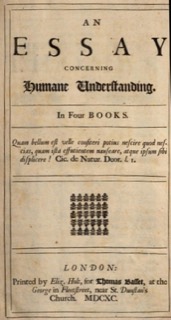
An Essay Concerning Human Understanding, Volume 2

by John Locke

Length: 127,537 words, about 510 pages, about 9 hours to read

Philosophy

Read An Essay Concerning Human Understanding, Volume 2 free, starting with its best pages and lines below. Listen to it free too, read aloud by your phone's own voice.

The best passages

Pages from the book itself, chosen to make you want to read on. Each opens in the reader at that exact spot.

CHAPTER I.

1. Man fitted to form articulated Sounds.

God, having designed man for a sociable creature, made him not only with an inclination, and under a necessity to have fellowship with those of his own kind, but furnished him also with language, which was to be the great instrument and common tie of society. Man, therefore, had by nature his organs so fashioned, as to be fit to frame articulate sounds, which we call words. But this was not enough to produce language; for parrots, and several other birds, will be taught to make articulate sounds distinct enough, which yet by no means are capable of language.

2. To use these sounds as Signs of Ideas.

Besides articulate sounds, therefore, it was further necessary that he should be able to use these sounds as signs of internal conceptions; and to make them stand as marks for the ideas within his own mind, whereby they might be made known to others, and the thoughts of men's minds be conveyed from one to another.

3. To make them general Signs.
Keep reading from here

CHAPTER II.

Man, though he have great variety of thoughts, and such from which others as well as himself might receive profit and delight; yet they are all within his own breast, invisible and hidden from others, nor can of themselves be made to appear. The comfort and advantage of society not being to be had without communication of thoughts, it was necessary that man should find out some external sensible signs, whereof those invisible ideas, which his thoughts are made up of, might be made known to others. For this purpose nothing was so fit, either for plenty or quickness, as those articulate sounds, which with so much ease and variety he found himself able to make. Thus we may conceive how WORDS, which were by nature so well adapted to that purpose, came to be made use of by men as the signs of their ideas; not by any natural connexion that there is between particular articulate sounds and certain ideas, for then there would be but one language amongst all men; but by a voluntary imposition, whereby such a word is made arbitrarily the mark of such an idea. The use, then, of words, is to be sensible marks of ideas; and the ideas they stand for are their proper and immediate signification.

2. Words, in their immediate Signification, are the sensible Signs of his Ideas who uses them.

Keep reading from here

CHAPTER IV.

12. The contrary shown in complex ideas, by instances of a Statue and Rainbow.

The case is quite otherwise in COMPLEX IDEAS; which, consisting of several simple ones, it is in the power of words, standing for the several ideas that make that composition, to imprint complex ideas in the mind which were never there before, and so make their names be understood. In such collections of ideas, passing under one name, definition, or the teaching the signification of one word by several others, has place, and may make us understand the names of things which never came within the reach of our senses; and frame ideas suitable to those in other men's minds, when they use those names: provided that none of the terms of the definition stand for any such simple ideas, which he to whom the explication is made has never yet had in his thought. Thus the word STATUE may be explained to a blind man by other words, when PICTURE cannot; his senses having given him the idea of figure, but not of colours, which therefore words cannot excite in him. This gained the prize to the painter against the statuary: each of which contending for the excellency of his art, and the statuary bragging that his was to be preferred, because it reached further, and even those who had lost their eyes could yet perceive the excellency of it. The painter agreed to refer himself to the judgment of a blind man; who being brought where there was a statue made by the one, and a picture drawn by the other;

Keep reading from here

CHAPTER X.

For, notwithstanding these learned disputants, these all-knowing doctors, it was to the unscholastic statesman that the governments of the world owed their peace, defence, and liberties; and from the illiterate and contemned mechanic (a name of disgrace) that they received the improvements of useful arts. Nevertheless, this artificial ignorance, and learned gibberish, prevailed mightily in these last ages, by the interest and artifice of those who found no easier way to that pitch of authority and dominion they have attained, than by amusing the men of business, and ignorant, with hard words, or employing the ingenious and idle in intricate disputes about unintelligible terms, and holding them perpetually entangled in that endless labyrinth. Besides, there is no such way to gain admittance, or give defence to strange and absurd doctrines, as to guard them round about with legions of obscure, doubtful, and undefined words. Which yet make these retreats more like the dens of robbers, or holes of foxes, than the fortresses of fair warriors; which, if it be hard to get them out of, it is not for the strength that is in them, but the briars and thorns, and the obscurity of the thickets they are beset with. For untruth being unacceptable to the mind of man, there is no other defence left for absurdity but obscurity.

10. But destroys the instruments of Knowledge and communication.

Keep reading from here

CHAPTER IV. OF THE REALITY OF KNOWLEDGE.

I DOUBT not but my reader, by this time, may be apt to think that I have been all this while only building a castle in the air; and be ready to say to me:—

'To what purpose all this stir? Knowledge, say you, is only the perception of the agreement or disagreement of our own ideas: but who knows what those ideas may be? Is there anything so extravagant as the imaginations of men's brains? Where is the head that has no chimeras in it? Or if there be a sober and a wise man, what difference will there be, by your rules, between his knowledge and that of the most extravagant fancy in the world? They both have their ideas, and perceive their agreement and disagreement one with another. If there be any difference between them, the advantage will be on the warm-headed man's side, as having the more ideas, and the more lively. And so, by your rules, he will be the more knowing. If it be true, that all knowledge lies only in the perception of the agreement or disagreement of our own ideas, the visions of an enthusiast and the reasonings of a sober man will be equally certain. It is no matter how things are: so a man observe but the agreement of his own imaginations, and talk conformably, it is all truth, all certainty. Such castles in the air will be as strongholds of truth, as the demonstrations of Euclid. That an harpy is not a centaur is by this way as certain knowledge, and as much a truth, as that a square is not a circle.

Keep reading from here

10 of the best lines

God, having designed man for a sociable creature, made him not only with an inclination, and under a necessity to have fellowship with those of his own kind, but furnished him also with language, which was to be the great instrument and common tie of society.

CHAPTER I.Keep reading from here

Though therefore it be the mind that makes the collection, it is the name which is as it were the knot that ties them fast together.

CHAPTER V.Keep reading from here

For untruth being unacceptable to the mind of man, there is no other defence left for absurdity but obscurity.

CHAPTER X.Keep reading from here

Eloquence, like the fair sex, has too prevailing beauties in it to suffer itself ever to be spoken against.

CHAPTER X.Keep reading from here

For I would fain know what substance exists, that has not something in it which manifestly baffles our understandings.

CHAPTER III.Keep reading from here

It is impossible that men should ever truly seek or certainly discover the agreement or disagreement of ideas themselves, whilst their thoughts flutter about, or stick only in sounds of doubtful and uncertain significations.

CHAPTER III.Keep reading from here

The Schools having made disputation the touchstone of men's abilities, and the criterion of knowledge, adjudged victory to him that kept the field: and he that had the last word was concluded to have the better of the argument, if not of the cause.

CHAPTER VII. OF MAXIMSKeep reading from here

In the knowledge of bodies, we must be content to glean what we can from particular experiments: since we cannot, from a discovery of their real essences, grasp at a time whole sheaves, and in bundles comprehend the nature and properties of whole species together.

CHAPTER XII. OF THE IMPROVEMENT OF OUR KNOWLEDGEKeep reading from here

This is certain, that what in one age was affirmed upon slight grounds, can never after come to be more valid in future ages by being often repeated.

CHAPTER XVI. OF THE DEGREES OF ASSENT.Keep reading from here

So that men will disbelieve their own eyes, renounce the evidence of their senses, and give their own experience the lie, rather than admit of anything disagreeing with these sacred tenets.

CHAPTER XIX. [not in early editions] CHAPTER XX.Keep reading from here

All 71 An Essay Concerning Human Understanding, Volume 2 quotes, with the words around each

Reviews

No reviews yet. Be the first, in the app.

Write a review in Doomreader

Contents

All 35 parts
  1. BOOK III. OF WORDS.
  2. BOOK IV. OF KNOWLEDGE AND PROBABILITY.
  3. BOOK III
  4. CHAPTER I.
  5. CHAPTER II.
  6. CHAPTER III.
  7. CHAPTER IV.
  8. CHAPTER V.
  9. CHAPTER VI.
  10. CHAPTER VII.
  11. CHAPTER VIII.
  12. CHAPTER IX.
  13. CHAPTER X.
  14. CHAPTER XI.
  15. BOOK IV
  16. CHAPTER I.
  17. CHAPTER II.
  18. CHAPTER III.
  19. CHAPTER IV. OF THE REALITY OF KNOWLEDGE.
  20. CHAPTER V. OF TRUTH IN GENERAL.
  21. CHAPTER VI. OF UNIVERSAL PROPOSITIONS: THEIR TRUTH AND CERTAINTY.
  22. CHAPTER VII. OF MAXIMS
  23. CHAPTER VIII. OF TRIFLING PROPOSITIONS.
  24. CHAPTER IX. OF OUR THREEFOLD KNOWLEDGE OF EXISTENCE.
  25. CHAPTER X. OF OUR KNOWLEDGE OF THE EXISTENCE OF A GOD.
  26. CHAPTER XI.
  27. CHAPTER XII. OF THE IMPROVEMENT OF OUR KNOWLEDGE
  28. CHAPTER XIII.
  29. CHAPTER XIV. OF JUDGMENT.
  30. CHAPTER XV. OF PROBABILITY.
  31. CHAPTER XVI. OF THE DEGREES OF ASSENT.
  32. CHAPTER XVII. OF REASON
  33. CHAPTER XVIII.
  34. CHAPTER XIX. [not in early editions] CHAPTER XX.
  35. CHAPTER XXI.

Listen to An Essay Concerning Human Understanding, Volume 2 free

An Essay Concerning Human Understanding, Volume 2 as a free audiobook: Doomreader reads any book aloud, free, in your phone's or computer's own voice. Open the book and tap listen, at the speed you like, hands free.

Want a more natural voice? The AI voices read with AI credits.

Listen free in Doomreader

Download An Essay Concerning Human Understanding, Volume 2 free

The whole book as an EPUB file, free and legal, from Project Gutenberg. It opens in any ebook app, or read it here in Doomreader with nothing to install.

Download the EPUB (0.3 MB)

More by John Locke

More like An Essay Concerning Human Understanding, Volume 2

About this edition

Text from Project Gutenberg. In the public domain in the USA. The Project Gutenberg License is kept inside the file. Every passage and line on this page is the book's own words, checked against the text.