Doomreader

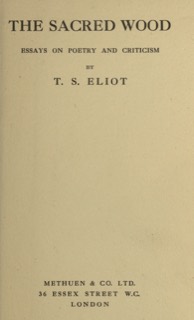
The Sacred Wood

by T. S. Eliot

Length: 45,341 words, about 181 pages, about 3 hours to read

Essays and ideas

Read The Sacred Wood free, starting with its best pages and lines below. Listen to it free too, read aloud by your phone's own voice.

The best passages

Pages from the book itself, chosen to make you want to read on. Each opens in the reader at that exact spot.

Chapter I

Coleridge was perhaps the greatest of English critics, and in a sense the last. After Coleridge we have Matthew Arnold; but Arnold—I think it will be conceded—was rather a propagandist for criticism than a critic, a popularizer rather than a creator of ideas. So long as this island remains an island (and we are no nearer the Continent than were Arnold’s contemporaries) the work of Arnold will be important; it is still a bridge across the Channel, and it will always have been good sense. Since Arnold’s attempt to correct his countrymen, English criticism has followed two directions. When a distinguished critic observed recently, in a newspaper article, that “poetry is the most highly organized form of intellectual activity,” we were conscious that we were reading neither Coleridge nor Arnold. Not only have the words “organized” and “activity,” occurring together in this phrase, that familiar vague suggestion of the scientific vocabulary which is characteristic of modern writing, but one asked questions which Coleridge and Arnold would not have permitted one to ask. How is it, for instance, that poetry is more “highly organized” than astronomy, physics, or pure mathematics, which we imagine to be, in relation to the scientist who practises them, “intellectual activity” of a pretty highly organized type? “Mere strings of words,” our critic continues with felicity and truth, “flung like dabs of paint across a blank canvas, may awaken surprise ... but have no significance whatever in the history of literature.” The phrases by which Arnold is best known may be inadequate, they may assemble more doubts than they dispel, but they usually have some meaning. And if a phrase like “the most highly organized form of intellectual activity” is the highest organization of thought of which contemporary criticism, in a distinguished representative, is capable, then, we conclude, modern criticism is degenerate.
Keep reading from here

Chapter I

Yet if the only form of tradition, of handing down, consisted in following the ways of the immediate generation before us in a blind or timid adherence to its successes, “tradition” should positively be discouraged. We have seen many such simple currents soon lost in the sand; and novelty is better than repetition. Tradition is a matter of much wider significance. It cannot be inherited, and if you want it you must obtain it by great labour. It involves, in the first place, the historical sense, which we may call nearly indispensable to anyone who would continue to be a poet beyond his twenty-fifth year; and the historical sense involves a perception, not only of the pastness of the past, but of its presence; the historical sense compels a man to write not merely with his own generation in his bones, but with a feeling that the whole of the literature of Europe from Homer and within it the whole of the literature of his own country has a simultaneous existence and composes a simultaneous order. This historical sense, which is a sense of the timeless as well as of the temporal and of the timeless and of the temporal together, is what makes a writer traditional. And it is at the same time what makes a writer most acutely conscious of his place in time, of his contemporaneity.

Keep reading from here

Chapter II

The analogy was that of the catalyst. When the two gases previously mentioned are mixed in the presence of a filament of platinum, they form sulphurous acid. This combination takes place only if the platinum is present; nevertheless the newly formed acid contains no trace of platinum, and the platinum itself is apparently unaffected; has remained inert, neutral, and unchanged. The mind of the poet is the shred of platinum. It may partly or exclusively operate upon the experience of the man himself; but, the more perfect the artist, the more completely separate in him will be the man who suffers and the mind which creates; the more perfectly will the mind digest and transmute the passions which are its material.

Keep reading from here

10 of the best lines

Once a poet is accepted, his reputation is seldom disturbed, for better or worse.

INTRODUCTIONKeep reading from here

And the free intelligence is that which is wholly devoted to inquiry.

Chapter IIKeep reading from here

The Arts insist that a man shall dispose of all that he has, even of his family tree, and follow art alone.

A Romantic AristocratKeep reading from here

No poet, no artist of any art, has his complete meaning alone.

Chapter IKeep reading from here

In fact, the bad poet is usually unconscious where he ought to be conscious, and conscious where he ought to be unconscious.

Chapter IIKeep reading from here

Some writers appear to believe that emotions gain in intensity through being inarticulate.

“Rhetoric” and Poetic DramaKeep reading from here

They are not fancy, because they have a logic of their own; and this logic illuminates the actual world, because it gives us a new point of view from which to inspect it.

Ben JonsonKeep reading from here

It must have a dominant tone; and if this be strong enough, the most heterogeneous emotions may be made to reinforce it.

Chapter IKeep reading from here

We have the same respect for Blake’s philosophy (and perhaps for that of Samuel Butler) that we have for an ingenious piece of home-made furniture: we admire the man who has put it together out of the odds and ends about the house.

Chapter IIKeep reading from here

The poet does not aim to excite—that is not even a test of his success—but to set something down; the state of the reader is merely that reader’s particular mode of perceiving what the poet has caught in words.

DanteKeep reading from here

All 74 The Sacred Wood quotes, with the words around each

Reviews

No reviews yet. Be the first, in the app.

Write a review in Doomreader

Contents

All 29 parts
  1. The Sacred Wood
  2. INTRODUCTION
  3. The Perfect Critic
  4. Chapter I
  5. Chapter II
  6. Imperfect Critics
  7. Swinburne as Critic
  8. A Romantic Aristocrat
  9. The Local Flavour
  10. A Note on the American Critic
  11. The French Intelligence
  12. Tradition and the Individual Talent
  13. Chapter I
  14. Chapter II
  15. Chapter III
  16. The Possibility of a Poetic Drama
  17. Euripides and Professor Murray
  18. “Rhetoric” and Poetic Drama
  19. Some Notes on the Blank Verse of Christopher Marlowe
  20. Hamlet and His Problems
  21. Ben Jonson
  22. Philip Massinger
  23. Chapter I
  24. Chapter II
  25. Swinburne as Poet
  26. Blake
  27. Chapter I
  28. Chapter II
  29. Dante

Listen to The Sacred Wood free

The Sacred Wood as a free audiobook: Doomreader reads any book aloud, free, in your phone's or computer's own voice. Open the book and tap listen, at the speed you like, hands free.

Want a more natural voice? The AI voices read with AI credits.

Listen free in Doomreader

Download The Sacred Wood free

The whole book as an EPUB file, free and legal, from Project Gutenberg. It opens in any ebook app, or read it here in Doomreader with nothing to install.

Download the EPUB (0.2 MB)

More by T. S. Eliot

More like The Sacred Wood

About this edition

Text from Project Gutenberg. In the public domain in the USA. The Project Gutenberg License is kept inside the file. Every passage and line on this page is the book's own words, checked against the text.