Doomreader

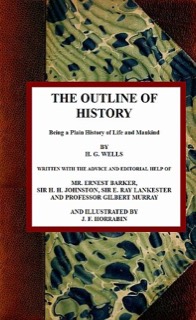
The Outline of History

by H. G. Wells

Length: 437,194 words, about 1,749 pages, about 31 hours to read

History and travel

Read The Outline of History free, starting with its best pages and lines below. Listen to it free too, read aloud by your phone's own voice.

The best passages

Pages from the book itself, chosen to make you want to read on. Each opens in the reader at that exact spot.

I THE EARTH IN SPACE AND TIME

THE earth on which we live is a spinning globe. Vast though it seems to us, it is a mere speck of matter in the greater vastness of space.

Space is, for the most part, emptiness. At great intervals there are in this emptiness flaring centres of heat and light, the “fixed stars.” They are all moving about in space, notwithstanding that they are called fixed stars, but for a long time men did not realize their motion. They are so vast and at such tremendous distances that their motion is not perceived. Only in the course of many thousands of years is it appreciable. These fixed stars are so far off that, for all their immensity, they seem to be, even when we look at them through the most powerful telescopes, mere points of light, brighter or less bright. A few, however, when we turn a telescope upon them, are seen to be whirls and clouds of shining vapour which we call nebulæ. They are so far off that a movement of millions of miles would be imperceptible.

One star, however, is so near to us that it is like a great ball of flame. This one is the sun. The sun is itself in its nature like a fixed star, but it differs from the other fixed stars in appearance because it is beyond comparison nearer than they are; and because it is nearer men have been able to learn something of its nature.
Keep reading from here

§ 1

WE do not know how life began upon the earth.[4]

Biologists, that is to say, students of life, have made guesses about these beginnings, but we will not discuss them here. Let us only note that they all agree that life began where the tides of those swift days spread and receded over the steaming beaches of mud and sand.

The atmosphere was much denser then, usually great cloud masses obscured the sun, frequent storms darkened the heavens. The land of those days, upheaved by violent volcanic forces, was a barren land, without vegetation, without soil. The almost incessant rain-storms swept down upon it, and rivers and torrents carried great loads of sediment out to sea, to become muds that hardened later into slates and shales, and sands that became sandstones. The geologists have studied the whole accumulation of these sediments as it remains to-day, from those of the earliest ages to the most recent. Of course the oldest deposits are the most distorted and changed and worn, and in them there is now no certain trace to be found of life at all. Probably the earliest forms of life were small and soft, leaving no evidence of their existence behind them. It was only when some of these living things developed skeletons and shells of lime and such-like hard material that they left fossil vestiges after they died, and so put themselves on record for examination.

Keep reading from here

§ 5

Were there mammals in the Mesozoic period?

This is a question not yet to be answered precisely. Patiently and steadily the geologists gather fresh evidence and reason out completer conclusions. At any time some new deposit may reveal fossils that will illuminate this question. Certainly either mammals, or the ancestors of the mammals, must have lived throughout the Mesozoic period. In the very opening chapter of the Mesozoic volume of the Record there were those Theriomorphous Reptiles to which we have already alluded, and in the later Mesozoic a number of small jaw-bones are found, entirely mammalian in character. But there is not a scrap, not a bone, to suggest that there lived any Mesozoic Mammal which could look a dinosaur in the face. The Mesozoic mammals or mammal-like reptiles—for we do not know clearly which they were—seem to have been all obscure little beasts of the size of mice and rats, more like a down-trodden order of reptiles than a distinct class; probably they still laid eggs and were developing only slowly their distinctive covering of hair. They lived away from big waters, and perhaps in the desolate uplands, as marmots do now; probably they lived there beyond the pursuit of the carnivorous dinosaurs. Some perhaps went on all fours, some chiefly went on their hind legs and clambered with their fore limbs.

Keep reading from here

§ 4

It was about 12,000 or fewer years ago that, with the spread of forests and a great change of the fauna, the long prevalence of the hunting life in Europe drew to its end. Reindeer vanished. Changing conditions frequently bring with them new diseases. There may have been prehistoric pestilences. For many centuries there may have been no men in Britain or Central Europe (Wright). For a time there were in Southern Europe drifting communities of some little known people who are called the Azilians.[41] They may have been transition generations; they may have been a different race. We do not know. Some authorities incline to the view that the Azilians were the first wave of a race which, as we shall see later, has played a great part in populating Europe, the dark-white or Mediterranean or Iberian race. These Azilian people have left behind them a multitude of pebbles, roughly daubed with markings of an unknown purport (see illus., p. 94). The use or significance of these Azilian pebbles is still a profound mystery. Was this some sort of token writing? Were they counters in some game? Did the Azilians play with these pebbles or tell a story with them, as imaginative children will do with bits of wood and stone nowadays? At present we are unable to cope with any of these questions.

Keep reading from here

§ 4

It was while Heraclius was engaged in restoring order in this already desolated Syria after the death of Chosroes II and before the final peace with Persia, that a strange message was brought to him. The bearer had ridden over to the imperial outpost at Bostra in the wilderness south of Damascus. The letter was in Arabic, the obscure Semitic language of the nomadic peoples of the southern desert; and probably only an interpretation reached him—presumably with deprecatory notes by the interpreter.

It was an odd, florid challenge from someone who called himself “Muhammad the Prophet of God.” This Muhammad, it appeared, called upon Heraclius to acknowledge the one true God and to serve him. Nothing else was definite in the document.

There is no record of the reception of this missive, and presumably it went unanswered. The emperor probably shrugged his shoulders, and was faintly amused at the incident.

But at Ctesiphon they knew more about this Muhammad. He was said to be a tiresome false prophet, who had incited Yemen, the rich province of Southern Arabia, to rebel against the King of Kings. Kavadh was much occupied with affairs. He had deposed and murdered his father Chosroes II, and he was attempting to reorganize the Persian military forces. To him also came a message identical with that sent to Heraclius. The thing angered him. He tore up the letter, flung the fragments at the envoy, and bade him begone.

Keep reading from here

10 of the best lines

Vast though it seems to us, it is a mere speck of matter in the greater vastness of space.

I THE EARTH IN SPACE AND TIMEKeep reading from here

The drawings even of Late Palæolithic man do not suggest that he paid any attention to sun or moon or stars or trees. He was preoccupied only with animals and men.

§ 1Keep reading from here

The Greeks did not grow a civilization of their own; they wrecked one and put another together upon and out of the ruins.

§ 2Keep reading from here

There seems to be no limit to the lies that honest but stupid disciples will tell for the glory of their master and for what they regard as the success of their propaganda.

§ 4Keep reading from here

He found the Nazarenes with a spirit and hope, and he left them Christians with the beginning of a creed.

§ 5[286]Keep reading from here

To this day their reconciliation is incomplete.

§ 1Keep reading from here

It is scarcely too much to say that the ordinary man thinks as little about political matters as he can, and stops thinking about them as soon as possible.

§ 6Keep reading from here

There was something inhuman even in their humanitarian zeal.

§ 10Keep reading from here

So soon as a government departs from that standard, it ceases to be anything more than “the gang in possession,” and its days are numbered.

§ 6[469]Keep reading from here

The ordinary educated man is so confused that he fails altogether to recognize even his oldest friends under their modern disguises.

FOOTNOTES:Keep reading from here

All 347 The Outline of History quotes, with the words around each

Reviews

No reviews yet. Be the first, in the app.

Write a review in Doomreader

Contents

All 348 parts
  1. INTRODUCTION
  2. SCHEME OF CONTENTS
  3. LIST OF MAPS AND ILLUSTRATIONS
  4. BOOK I THE MAKING OF OUR WORLD
  5. THE OUTLINE OF HISTORY
  6. I THE EARTH IN SPACE AND TIME
  7. II THE RECORD OF THE ROCKS
  8. § 1
  9. § 2
  10. III NATURAL SELECTION AND THE CHANGES OF SPECIES
  11. IV THE INVASION OF THE DRY LAND BY LIFE
  12. § 1
  13. § 2
  14. V CHANGES IN THE WORLD’S CLIMATE
  15. § 1
  16. § 2
  17. § 3
  18. § 4
  19. VI THE AGE OF REPTILES
  20. § 1
  21. § 2
  22. § 3
  23. § 4
  24. § 5
  25. VII THE AGE OF MAMMALS
  26. § 1
  27. § 2
  28. § 3
  29. § 4
  30. § 5
  31. BOOK II THE MAKING OF MEN
  32. VIII THE ANCESTRY OF MAN[20]
  33. § 1
  34. § 2
  35. § 3
  36. § 4
  37. § 5
  38. IX THE NEANDERTHAL MEN, AN EXTINCT RACE (The Early Palæolithic Age[29])
  39. § 1
  40. § 2
  41. § 3
  42. X THE LATER POSTGLACIAL PALÆOLITHIC MEN, THE FIRST TRUE MEN (Later Palæolithic Age)
  43. § 1
  44. § 2
  45. § 3
  46. § 4
  47. § 5
  48. XI NEOLITHIC MAN IN EUROPE[45]
  49. § 1
  50. § 2
  51. § 3
  52. § 4
  53. § 5
  54. § 6
  55. XII EARLY THOUGHT[62]
  56. § 1
  57. § 2
  58. § 3
  59. § 4
  60. § 5
  61. § 6
  62. XIII THE RACES OF MANKIND
  63. § 1
  64. § 2
  65. § 3
  66. § 4
  67. § 5
  68. XIV THE LANGUAGES OF MANKIND
  69. § 1
  70. § 2
  71. § 3
  72. § 4
  73. § 5
  74. § 6
  75. § 7
  76. § 8
  77. § 9
  78. BOOK III THE DAWN OF HISTORY
  79. XV THE ARYAN-SPEAKING PEOPLES IN PREHISTORIC TIMES
  80. § 1
  81. § 2
  82. § 3
  83. XVI THE FIRST CIVILIZATIONS
  84. § 1
  85. § 2A
  86. § 2B
  87. § 2C
  88. §2D
  89. §2E
  90. § 3
  91. § 4
  92. § 5
  93. § 6
  94. XVII SEA PEOPLES AND TRADING PEOPLES
  95. § 1
  96. § 2
  97. § 3
  98. § 4
  99. § 5
  100. XVIII WRITING
  101. § 1
  102. § 2
  103. § 3
  104. § 4
  105. XIX GODS AND STARS, PRIESTS AND KINGS
  106. § 1
  107. § 2
  108. § 3[136]
  109. § 4
  110. § 5[139]
  111. § 6
  112. § 7[143]
  113. § 8
  114. XX SERFS, SLAVES, SOCIAL CLASSES, AND FREE INDIVIDUALS
  115. § 1
  116. § 2
  117. § 3
  118. § 4
  119. § 5
  120. § 6
  121. § 7
  122. § 8
  123. BOOK IV JUDEA, GREECE, AND INDIA
  124. XXI THE HEBREW SCRIPTURES AND THE PROPHETS[157]
  125. § 1
  126. § 2
  127. § 3
  128. § 4
  129. XXII THE GREEKS AND THE PERSIANS[169]
  130. § 1
  131. § 2
  132. § 3
  133. § 4
  134. § 5
  135. § 6
  136. § 7
  137. § 8
  138. § 9
  139. § 10
  140. XXIII GREEK THOUGHT AND LITERATURE[182]
  141. § 1
  142. § 2
  143. § 3
  144. § 4
  145. § 5
  146. § 6
  147. § 7
  148. § 8
  149. XXIV THE CAREER OF ALEXANDER THE GREAT[195]
  150. § 1
  151. § 2
  152. § 3
  153. § 4
  154. § 5
  155. § 6
  156. § 7
  157. § 8
  158. XXV SCIENCE AND RELIGION AT ALEXANDRIA[203]
  159. § 1
  160. § 2
  161. § 3
  162. XXVI THE RISE AND SPREAD OF BUDDHISM[211]
  163. § 1
  164. § 2
  165. § 3
  166. § 4
  167. § 5
  168. § 6
  169. § 7
  170. BOOK V THE RISE AND COLLAPSE OF THE ROMAN EMPIRE
  171. XXVII THE TWO WESTERN REPUBLICS[224]
  172. § 1
  173. § 2[228]
  174. § 3
  175. § 4
  176. § 5
  177. § 6
  178. § 7
  179. § 8
  180. § 9
  181. XXVIII FROM TIBERIUS GRACCHUS TO THE GOD EMPEROR IN ROME
  182. § 1
  183. § 2
  184. § 3
  185. § 4
  186. § 5
  187. § 6
  188. § 7
  189. XXIX THE CÆSARS BETWEEN THE SEA AND THE GREAT PLAINS OF THE OLD WORLD[256]
  190. § 1
  191. § 2
  192. § 3
  193. § 4[262]
  194. § 5
  195. § 6
  196. BOOK VI CHRISTIANITY AND ISLAM
  197. XXX THE BEGINNINGS, THE RISE, AND THE DIVISIONS OF CHRISTIANITY
  198. § 1
  199. § 2
  200. § 3
  201. § 4
  202. § 5[286]
  203. § 6
  204. § 7
  205. § 8
  206. § 9
  207. § 10
  208. XXXI SEVEN CENTURIES IN ASIA (CIRCA 50 B.C. TO A.D. 650)
  209. § 1
  210. § 2
  211. § 3
  212. § 4
  213. § 5
  214. § 6
  215. § 7[311]
  216. § 8
  217. § 9[316]
  218. THE OUTLINE OF HISTORY
  219. SCHEME OF CONTENTS
  220. BOOK VI (Continued) CHRISTIANITY AND ISLAM (Continued)
  221. THE OUTLINE OF HISTORY
  222. XXXII MUHAMMAD AND ISLAM[319]
  223. § 1
  224. § 2
  225. § 3
  226. § 4
  227. § 5
  228. § 6
  229. § 7
  230. § 8
  231. XXXIII CHRISTENDOM AND THE CRUSADES
  232. § 1
  233. § 2
  234. § 3
  235. § 4
  236. § 5
  237. § 6
  238. § 7
  239. § 8
  240. § 9
  241. § 10
  242. §11
  243. § 12
  244. § 13[359]
  245. § 14
  246. BOOK VII THE MONGOL EMPIRES OF THE LAND WAYS AND THE NEW EMPIRES OF THE SEA WAYS
  247. XXXIV THE GREAT EMPIRE OF JENGIS KHAN AND HIS SUCCESSORS (The Age of the Land Ways)
  248. § 1
  249. § 2
  250. § 3
  251. § 4
  252. § 5
  253. § 5A
  254. § 5B
  255. § 5C
  256. § 5D
  257. § 5E[367]
  258. § 5F
  259. XXXV THE RENASCENCE OF WESTERN CIVILIZATION[371] (Land Ways Give Place to Sea Ways)
  260. § 1
  261. § 2
  262. § 3
  263. § 4
  264. § 5
  265. § 6
  266. § 7
  267. § 8
  268. § 9
  269. § 10
  270. § 11A
  271. § 11B
  272. § 11C
  273. BOOK VIII THE AGE OF THE GREAT POWERS
  274. XXXVI PRINCES, PARLIAMENTS, AND POWERS
  275. § 1
  276. § 2
  277. § 3
  278. § 4
  279. § 5
  280. § 6
  281. § 7
  282. § 8
  283. § 9
  284. § 10
  285. § 11
  286. § 12[415]
  287. XXXVII THE NEW DEMOCRATIC REPUBLICS OF AMERICA AND FRANCE
  288. § 1[418]
  289. § 2
  290. § 3
  291. § 4
  292. § 5
  293. § 6
  294. § 7[434]
  295. § 8
  296. § 9
  297. § 10
  298. § 11
  299. § 12
  300. § 13
  301. XXXVIII THE CAREER OF NAPOLEON BONAPARTE[448]
  302. § 1
  303. § 2
  304. § 3
  305. § 4
  306. § 5
  307. § 6
  308. § 7[455]
  309. XXXIX THE REALITIES AND IMAGINATIONS OF THE NINETEENTH CENTURY[457]
  310. § 1
  311. § 2
  312. § 3
  313. § 4
  314. § 5
  315. § 6[469]
  316. § 7
  317. § 8
  318. § 9
  319. § 10
  320. § 11
  321. § 12
  322. § 13
  323. XL THE INTERNATIONAL CATASTROPHE OF 1914[489]
  324. § 1
  325. § 2
  326. § 3
  327. § 4
  328. § 5
  329. § 6
  330. § 7
  331. § 8[501]
  332. § 9
  333. § 10
  334. § 11[517]
  335. § 12
  336. § 13
  337. § 14
  338. § 15
  339. BOOK IX THE NEXT STAGE IN HISTORY
  340. XLI THE POSSIBLE UNIFICATION OF THE WORLD INTO ONE COMMUNITY OF KNOWLEDGE AND WILL
  341. § 1
  342. § 2
  343. § 3
  344. § 4
  345. § 5
  346. TIME CHARTS AND CHRONOLOGICAL TABLE
  347. CHRONOLOGICAL TABLE
  348. FOOTNOTES:

Listen to The Outline of History free

The Outline of History as a free audiobook: Doomreader reads any book aloud, free, in your phone's or computer's own voice. Open the book and tap listen, at the speed you like, hands free.

Want a more natural voice? The AI voices read with AI credits.

Listen free in Doomreader

Download The Outline of History free

The whole book as an EPUB file, free and legal, from Project Gutenberg. It opens in any ebook app, or read it here in Doomreader with nothing to install.

Download the EPUB (1.4 MB)

More by H. G. Wells

More like The Outline of History

About this edition

Text from Project Gutenberg. In the public domain in the USA. The Project Gutenberg License is kept inside the file. Every passage and line on this page is the book's own words, checked against the text.