Chapter XI
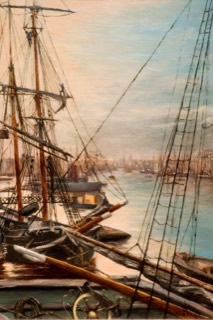
I had been some time at sea before I became aware of the fact that hearing plays a perceptible part in gauging the force of the wind. It was at night. The ship was one of those iron wool-clippers that the Clyde had floated out in swarms upon the world during the seventh decade of the last century. It was a fine period in shipbuilding, and also, I might say, a period of over-masting. The spars rigged up on the narrow hulls were indeed tall then, and the ship of which I think, with her coloured-glass skylight ends bearing the motto, “Let Glasgow Flourish,” was certainly one of the most heavily-sparred specimens. She was built for hard driving, and unquestionably she got all the driving she could stand. Our captain was a man famous for the quick passages he had been used to make in the old Tweed, a ship famous the world over for her speed. The Tweed had been a wooden vessel, and he brought the tradition of quick passages with him into the iron clipper. I was the junior in her, a third mate, keeping watch with the chief officer; and it was just during one of the night watches in a strong, freshening breeze that I overheard two men in a sheltered nook of the main deck exchanging these informing remarks. Said one:
“Should think ’twas time some of them light sails were coming off her.”
And the other, an older man, uttered grumpily:
“No fear! not while the chief mate’s on deck. He’s that deaf he can’t tell how much wind there is.”
And, indeed, poor P⸺, quite young, and a smart seaman, was very hard of hearing. At the same time, he had the name of being the very devil of a fellow for carrying on sail on a ship.