Doomreader

The History of the Decline and Fall of the Roman Empire

by Edward Gibbon

Length: 1,602,851 words, about 6,411 pages, about 112 hours to read

History and travel

Read The History of the Decline and Fall of the Roman Empire free, starting with its best pages and lines below. Listen to it free too, read aloud by your phone's own voice.

What it is

A narrative history of the Roman Empire from the time of Trajan to the fall of Constantinople.

The best passages

Pages from the book itself, chosen to make you want to read on. Each opens in the reader at that exact spot.

Chapter I

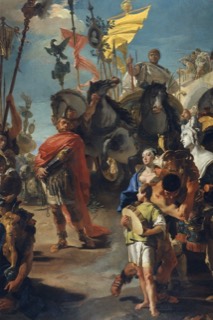
In the second century of the Christian Era, the empire of Rome comprehended the fairest part of the earth, and the most civilized portion of mankind. The frontiers of that extensive monarchy were guarded by ancient renown and disciplined valor. The gentle but powerful influence of laws and manners had gradually cemented the union of the provinces. Their peaceful inhabitants enjoyed and abused the advantages of wealth and luxury. The image of a free constitution was preserved with decent reverence: the Roman senate appeared to possess the sovereign authority, and devolved on the emperors all the executive powers of government. During a happy period of more than fourscore years, the public administration was conducted by the virtue and abilities of Nerva, Trajan, Hadrian, and the two Antonines. It is the design of this, and of the two succeeding chapters, to describe the prosperous condition of their empire; and afterwards, from the death of Marcus Antoninus, to deduce the most important circumstances of its decline and fall: a revolution which will ever be remembered, and is still felt by the nations of the earth.

The principal conquests of the Romans were achieved under the republic; and the emperors, for the most part, were satisfied with preserving those dominions which had been acquired by the policy of the senate, the active emulations of the consuls, and the martial enthusiasm of the people.

Keep reading from here

Chapter I

It was an ancient tradition that, when the Capitol was founded by one of the Roman kings, the god Terminus (who presided over boundaries, and was represented according to the fashion of that age by a large stone) alone, among all the inferior deities, refused to yield his place to Jupiter himself. A favorable inference was drawn from his obstinacy, which was interpreted by the augurs as a sure presage that the boundaries of the Roman power would never recede. During many ages, the prediction, as it is usual, contributed to its own accomplishment. But though Terminus had resisted the majesty of Jupiter, he submitted to the authority of the emperor Hadrian. The resignation of all the eastern conquests of Trajan was the first measure of his reign. He restored to the Parthians the election of an independent sovereign; withdrew the Roman garrisons from the provinces of Armenia, Mesopotamia, and Assyria; and, in compliance with the precept of Augustus, once more established the Euphrates as the frontier of the empire. Censure, which arraigns the public actions and the private motives of princes, has ascribed to envy a conduct which might be attributed to the prudence and moderation of Hadrian. The various character of that emperor, capable, by turns, of the meanest and the most generous sentiments, may afford some color to the suspicion. It was, however, scarcely in his power to place the superiority of his predecessor in a more conspicuous light, than by thus confessing himself unequal to the task of defending the conquests of Trajan.

Keep reading from here

Chapter II

It was once proposed to discriminate the slaves by a peculiar habit; but it was justly apprehended that there might be some danger in acquainting them with their own numbers. Without interpreting in their utmost strictness the liberal appellations of legions and myriads, we may venture to pronounce that the proportion of slaves who were valued as property was more considerable than that of servants, who can be computed only as an expense. The youths of a promising genius were instructed in the arts and sciences, and their price was ascertained by the degree of their skill and talents. Almost every profession, either liberal or mechanical, might be found in the household of an opulent senator. The ministers of pomp and sensuality were multiplied beyond the conception of modern luxury. It was more for the interest of the merchant or manufacturer to purchase than to hire his workmen; and in the country slaves were employed as the cheapest and most laborious instruments of agriculture. To confirm the general observation, and to display the multitude of slaves, we might allege a variety of particular instances. It was discovered, on a very melancholy occasion, that four hundred slaves were maintained in a single palace of Rome. The same number of four hundred belonged to an estate which an African widow, of a very private condition, resigned to her son, whilst she reserved for herself a much larger share of her property. A freedman, under the name of Augustus, though his fortune had suffered great losses in the civil wars, left behind him 3, yoke of oxen, 250, head of smaller cattle, and what was almost included in the description of cattle, 4, slaves.

Keep reading from here

Chapter II

The family of Herod, at least after it had been favored by fortune, was lineally descended from Cimon and Miltiades, Theseus and Cecrops, Aeacus and Jupiter. But the posterity of so many gods and heroes was fallen into the most abject state. His grandfather had suffered by the hands of justice, and Julius Atticus, his father, must have ended his life in poverty and contempt, had he not discovered an immense treasure buried under an old house, the last remains of his patrimony. According to the rigor of the law, the emperor might have asserted his claim, and the prudent Atticus prevented, by a frank confession, the officiousness of informers. But the equitable Nerva, who then filled the throne, refused to accept any part of it, and commanded him to use, without scruple, the present of fortune. The cautious Athenian still insisted that the treasure was too considerable for a subject, and that he knew not how to use it. Abuse it then, replied the monarch, with a good-natured peevishness; for it is your own. Many will be of opinion that Atticus literally obeyed the emperor’s last instructions, since he expended the greatest part of his fortune, which was much increased by an advantageous marriage, in the service of the public. He had obtained for his son Herod the prefecture of the free cities of Asia; and the young magistrate, observing that the town of Troas was indifferently

Keep reading from here

Chapter XLV

While Alboin served under his father’s standard, he encountered in battle, and transpierced with his lance, the rival prince of the Gepidae. The Lombards, who applauded such early prowess, requested his father with unanimous acclamations that the heroic youth, who had shared the dangers of the field, might be admitted to the feast of victory. “You are not unmindful,” replied the inflexible Audoin, “of the wise customs of our ancestors. Whatever may be his merit, a prince is incapable of sitting at table with his father till he has received his arms from a foreign and royal hand.” Alboin bowed with reverence to the institutions of his country, selected forty companions, and boldly visited the court of Turisund, king of the Gepidae, who embraced and entertained, according to the laws of hospitality, the murderer of his son. At the banquet, whilst Alboin occupied the seat of the youth whom he had slain, a tender remembrance arose in the mind of Turisund. “How dear is that place! how hateful is that person!” were the words that escaped, with a sigh, from the indignant father. His grief exasperated the national resentment of the Gepidae; and Cunimund, his surviving son, was provoked by wine, or fraternal affection, to the desire of vengeance. “The Lombards,” said the rude Barbarian, “resemble, in figure and in smell, the mares of our Sarmatian plains.” And this insult was a coarse allusion to the white bands which enveloped their legs. “Add another resemblance,” replied an audacious Lombard; “you have felt how strongly they kick.

Keep reading from here

10 of the best lines

In the second century of the Christian Era, the empire of Rome comprehended the fairest part of the earth, and the most civilized portion of mankind.

Chapter IKeep reading from here

“He who sows the ground with care and diligence acquires a greater stock of religious merit than he could gain by the repetition of ten thousand prayers.”

Chapter VIIIKeep reading from here

So urgent on the vulgar is the necessity of believing that the fall of any system of mythology will most probably be succeeded by the introduction of some other mode of superstition.

Chapter XVKeep reading from here

It was indeed a treasure which derived its value only from opinion

Chapter XXIIIKeep reading from here

“Herodias is again furious; Herodias again dances; she once more requires the head of John”

Chapter XXXIIKeep reading from here

The first of the Romans still submitted to be the slave of his wife

Chapter XLIIIKeep reading from here

In war he seemed ignorant of peace, in peace he appeared incapable of war.

Chapter XLVIIIKeep reading from here

“If I die,” said he, “your master is delivered from his fears. If I live, this must determine between us. If I am vanquished, I can return without reluctance to the homely fare of my youth.”

Chapter LIIKeep reading from here

Assassination is the last resource of cowards.

Chapter LXIIKeep reading from here

It was among the ruins of the Capitol that I first conceived the idea of a work which has amused and exercised near twenty years of my life, and which, however inadequate to my own wishes, I finally deliver to the curiosity and candor of the public.

Chapter LXXIKeep reading from here

All 314 The History of the Decline and Fall of the Roman Empire quotes, with the words around each

Reviews

No reviews yet. Be the first, in the app.

Write a review in Doomreader

Contents

All 77 parts
  1. Preface by the Editor
  2. Preface of the Author
  3. Preface to the First Volume
  4. Introduction
  5. Chapter I
  6. Chapter II
  7. Chapter III
  8. Chapter IV
  9. Chapter V
  10. Chapter VI
  11. Chapter VII
  12. Chapter VIII
  13. Chapter IX
  14. Chapter X
  15. Chapter XI
  16. Chapter XII
  17. Chapter XIII
  18. Chapter XIV
  19. Chapter XV
  20. Chapter XVI
  21. Chapter XVII
  22. Chapter XVIII
  23. Chapter XIX
  24. Chapter XX
  25. Chapter XXI
  26. Chapter XXII
  27. Chapter XXIII
  28. Chapter XXIV
  29. Chapter XXV
  30. Chapter XXVI
  31. Chapter XXVII
  32. Chapter XXVIII
  33. Chapter XXIX
  34. Chapter XXX
  35. Chapter XXXI
  36. Chapter XXXII
  37. Chapter XXXIII
  38. Chapter XXXIV
  39. Chapter XXXV
  40. Chapter XXXVI
  41. Chapter XXXVII
  42. Chapter XXXVIII
  43. General Observations on the Fall of the Roman Empire in the West
  44. Chapter XXXIX
  45. Chapter XL
  46. Chapter XLI
  47. Chapter XLII
  48. Chapter XLIII
  49. Chapter XLIV
  50. Chapter XLV
  51. Chapter XLVI
  52. Chapter XLVII
  53. Chapter XLVIII
  54. Chapter XLIX
  55. Chapter L
  56. Chapter LI
  57. Chapter LII
  58. Chapter LIII
  59. Chapter LIV
  60. Chapter LV
  61. Chapter LVI
  62. Chapter LVII
  63. Chapter LVIII
  64. Chapter LIX
  65. Chapter LX
  66. Chapter LXI
  67. Chapter LXII
  68. Chapter LXIII
  69. Chapter LXIV
  70. Chapter LXV
  71. Chapter LXVI
  72. Chapter LXVII
  73. Chapter LXVIII
  74. Chapter LXIX
  75. Chapter LXX
  76. Chapter LXXI
  77. Appendix

Listen to The History of the Decline and Fall of the Roman Empire free

The History of the Decline and Fall of the Roman Empire as a free audiobook: Doomreader reads any book aloud, free, in your phone's or computer's own voice. Open the book and tap listen, at the speed you like, hands free.

Want a more natural voice? The AI voices read with AI credits.

Listen free in Doomreader

Download The History of the Decline and Fall of the Roman Empire free

The whole book as an EPUB file, free and legal, from Standard Ebooks. It opens in any ebook app, or read it here in Doomreader with nothing to install.

Download the EPUB (7.4 MB)

More like The History of the Decline and Fall of the Roman Empire

About this edition

Text from Standard Ebooks. Standard Ebooks dedicate their edition to the public domain (CC0 1.0). Every passage and line on this page is the book's own words, checked against the text.