Doomreader

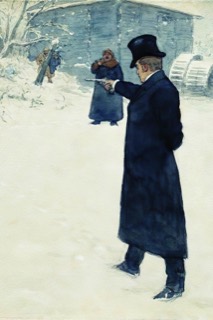
The Duel

by Anton Chekhov

Length: 40,735 words, about 163 pages, about 3 hours to read

Novels

Read The Duel free, starting with its best pages and lines below. Listen to it free too, read aloud by your phone's own voice.

What it is

Von Koren, an educated zoologist, finds the slovenly lifestyle of Laevsky, a drinker, to be worthless. Finally, Laevsky can’t take it any more.

The best passages

Pages from the book itself, chosen to make you want to read on. Each opens in the reader at that exact spot.

Chapter I

It was eight o’clock in the morning⁠—the time when the officers, the local officials, and the visitors usually took their morning dip in the sea after the hot, stifling night, and then went into the pavilion to drink tea or coffee. Ivan Andreitch Laevsky, a thin, fair young man of twenty-eight, wearing the cap of a clerk in the Ministry of Finance and with slippers on his feet, coming down to bathe, found a number of acquaintances on the beach, and among them his friend Samoylenko, the army doctor.

With his big cropped head, short neck, his red face, his big nose, his shaggy black eyebrows and grey whiskers, his stout puffy figure and his hoarse military bass, this Samoylenko made on every newcomer the unpleasant impression of a gruff bully; but two or three days after making his acquaintance, one began to think his face extraordinarily good-natured, kind, and even handsome. In spite of his clumsiness and rough manner, he was a peaceable man, of infinite kindliness and goodness of heart, always ready to be of use. He was on familiar terms with everyone in the town, lent everyone money, doctored everyone, made matches, patched up quarrels, arranged picnics at which he cooked shashlik and an awfully good soup of grey mullets. He was always looking after other people’s affairs and trying to interest someone on their behalf, and was always delighted about something. The general opinion about him was that he was without faults of character.
Keep reading from here

Chapter III

“I saw Vanya Laevsky today. He is having a hard time of it, poor fellow! The material side of life is not encouraging for him, and the worst of it is all this psychology is too much for him. I’m sorry for the lad.”

“Well, that is a person I am not sorry for,” said Von Koren. “If that charming individual were drowning, I would push him under with a stick and say, ‘Drown, brother, drown away.’⁠ ⁠…”

“That’s untrue. You wouldn’t do it.”

“Why do you think that?” The zoologist shrugged his shoulders. “I’m just as capable of a good action as you are.”

“Is drowning a man a good action?” asked the deacon, and he laughed.

“Laevsky? Yes.”

“I think there is something amiss with the soup⁠ ⁠…” said Samoylenko, anxious to change the conversation.

“Laevsky is absolutely pernicious and is as dangerous to society as the cholera microbe,” Von Koren went on. “To drown him would be a service.”

Keep reading from here

Chapter VI

Five hundred paces from the duhan the carriages stopped. Samoylenko selected a small meadow round which there were scattered stones convenient for sitting on, and a fallen tree blown down by the storm with roots overgrown by moss and dry yellow needles. Here there was a fragile wooden bridge over the stream, and just opposite on the other bank there was a little barn for drying maize, standing on four low piles, and looking like the hut on hen’s legs in the fairy tale; a little ladder sloped from its door.

The first impression in all was a feeling that they would never get out of that place again. On all sides wherever they looked, the mountains rose up and towered above them, and the shadows of evening were stealing rapidly, rapidly from the duhan and dark cypress, making the narrow winding valley of the Black River narrower and the mountains higher. They could hear the river murmuring and the unceasing chirrup of the grasshoppers.

“Enchanting!” said Marya Konstantinovna, heaving deep sighs of ecstasy. “Children, look how fine! What peace!”

“Yes, it really is fine,” assented Laevsky, who liked the view, and for some reason felt sad as he looked at the sky and then at the blue smoke rising from the chimney of the duhan. “Yes, it is fine,” he repeated.

Keep reading from here

Chapter IX

When they got home, Laevsky and Nadyezhda Fyodorovna went into their dark, stuffy, dull rooms. Both were silent. Laevsky lighted a candle, while Nadyezhda Fyodorovna sat down, and without taking off her cloak and hat, lifted her melancholy, guilty eyes to him.

He knew that she expected an explanation from him, but an explanation would be wearisome, useless and exhausting, and his heart was heavy because he had lost control over himself and been rude to her. He chanced to feel in his pocket the letter which he had been intending every day to read to her, and thought if he were to show her that letter now, it would turn her thoughts in another direction.

“It is time to define our relations,” he thought. “I will give it her; what is to be will be.”

He took out the letter and gave it her.

“Read it. It concerns you.”

Saying this, he went into his own room and lay down on the sofa in the dark without a pillow. Nadyezhda Fyodorovna read the letter, and it seemed to her as though the ceiling were falling and the walls were closing in on her. It seemed suddenly dark and shut in and terrible. She crossed herself quickly three times and said:

“Give him peace, O Lord⁠ ⁠… give him peace.⁠ ⁠…”

And she began crying.

“Vanya,” she called. “Ivan Andreitch!”

There was no answer. Thinking that Laevsky had come in and was standing behind her chair, she sobbed like a child, and said:

Keep reading from here

Chapter XIII

Laevsky received two notes; he opened one and read: “Don’t go away, my darling.”

“Who could have written that?” he thought. “Not Samoylenko, of course. And not the deacon, for he doesn’t know I want to go away. Von Koren, perhaps?”

The zoologist bent over the table and drew a pyramid. Laevsky fancied that his eyes were smiling.

“Most likely Samoylenko⁠ ⁠… has been gossiping,” thought Laevsky.

In the other note, in the same disguised angular handwriting with long tails to the letters, was written: “Somebody won’t go away on Saturday.”

“A stupid gibe,” thought Laevsky. “Friday, Friday.⁠ ⁠…”

Something rose in his throat. He touched his collar and coughed, but instead of a cough a laugh broke from his throat.

“Ha-ha-ha!” he laughed. “Ha-ha-ha! What am I laughing at? Ha-ha-ha!”

He tried to restrain himself, covered his mouth with his hand, but the laugh choked his chest and throat, and his hand could not cover his mouth.

“How stupid it is!” he thought, rolling with laughter. “Have I gone out of my mind?”

The laugh grew shriller and shriller, and became something like the bark of a lapdog. Laevsky tried to get up from the table, but his legs would not obey him and his right hand was strangely, without his volition, dancing on the table, convulsively clutching and crumpling up the bits of paper. He saw looks of wonder, Samoylenko’s grave, frightened face, and the eyes of the zoologist full of cold irony and disgust, and realised that he was in hysterics.

Keep reading from here

10 of the best lines

He had only two weaknesses: he was ashamed of his own good nature, and tried to disguise it by a surly expression and an assumed gruffness; and he liked his assistants and his soldiers to call him “Your Excellency,” although he was only a civil councillor.

Chapter IKeep reading from here

I am for her an indispensable, integral part of her boudoir.

Chapter IKeep reading from here

He would not murder her, of course, but if he had been on a jury now, he would have acquitted the murderer.

Chapter IIKeep reading from here

His existence is confined within this narrow programme like an egg within its shell.

Chapter IIIKeep reading from here

The first impression in all was a feeling that they would never get out of that place again.

Chapter VIKeep reading from here

We curse vice only behind its back, and that’s like making a long nose at it round a corner.

Chapter VIIIKeep reading from here

A husband ought to know nothing, and his wife ought to be as neat as a little angel in his presence.

Chapter XKeep reading from here

Yes, I want to go away. Yes, I get into debt, I drink, I am living with another man’s wife, I’m hysterical, I’m ordinary.

Chapter XVKeep reading from here

Why, I have an uncle, a priest, and he believes so that when in time of drought he goes out into the fields to pray for rain, he takes his umbrella and leather overcoat for fear of getting wet through on his way home. That’s faith!

Chapter XVIKeep reading from here

Only the rich man distinguishes your God from my God; for the poor man it is all the same.

Chapter XXKeep reading from here

All 46 The Duel quotes, with the words around each

Reviews

No reviews yet. Be the first, in the app.

Write a review in Doomreader

Contents

  1. Chapter I
  2. Chapter II
  3. Chapter III
  4. Chapter IV
  5. Chapter V
  6. Chapter VI
  7. Chapter VII
  8. Chapter VIII
  9. Chapter IX
  10. Chapter X
  11. Chapter XI
  12. Chapter XII
  13. Chapter XIII
  14. Chapter XIV
  15. Chapter XV
  16. Chapter XVI
  17. Chapter XVII
  18. Chapter XVIII
  19. Chapter XIX
  20. Chapter XX
  21. Chapter XXI

Listen to The Duel free

The Duel as a free audiobook: Doomreader reads any book aloud, free, in your phone's or computer's own voice. Open the book and tap listen, at the speed you like, hands free.

Want a more natural voice? The AI voices read with AI credits.

Listen free in Doomreader

Download The Duel free

The whole book as an EPUB file, free and legal, from Standard Ebooks. It opens in any ebook app, or read it here in Doomreader with nothing to install.

Download the EPUB (1.6 MB)

More by Anton Chekhov

More like The Duel

About this edition

Text from Standard Ebooks. Standard Ebooks dedicate their edition to the public domain (CC0 1.0). Every passage and line on this page is the book's own words, checked against the text.