Doomreader

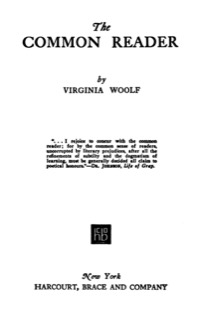
The Common Reader

by Virginia Woolf

Length: 84,837 words, about 339 pages, about 6 hours to read

Essays and ideas

Read The Common Reader free, starting with its best pages and lines below. Listen to it free too, read aloud by your phone's own voice.

The best passages

Pages from the book itself, chosen to make you want to read on. Each opens in the reader at that exact spot.

The Pastons and Chaucer[1]

The tower of Caister Castle still rises ninety feet into the air, and the arch still stands from which Sir John Fastolf's barges sailed out to fetch stone for the building of the great castle. But now jackdaws nest on the tower, and of the castle, which once covered six acres of ground, only ruined walls remain, pierced by loop-holes and surmounted by battlements, though there are neither archers within nor cannon without. As for the "seven religious men" and the "seven poor folk" who should, at this very moment, be praying for the souls of Sir John and his parents, there is no sign of them nor sound of their prayers. The place is a ruin. Antiquaries speculate and differ.

Not so very far off lie more ruins—the ruins of Bromholm Priory, where John Paston was buried, naturally enough, since his house was only a mile or so away, lying on low ground by the sea, twenty miles north of Norwich. The coast is dangerous, and the land, even in our time, inaccessible. Nevertheless the little bit of wood at Bromholm, the fragment of the true Cross, brought pilgrims incessantly to the Priory, and sent them away with eyes opened and limbs straightened. But some of them with their newly-opened eyes saw a sight which shocked them—the grave of John Paston in Bromholm Priory without a tombstone. The news spread over the country-side. The Pastons had fallen; they that had been so powerful could no longer afford a stone to put above John Paston's head.
Keep reading from here

The Pastons and Chaucer[1]

For let us imagine, in the most desolate part of England known to us at the present moment, a raw, new-built house, without telephone, bathroom, or drains, arm-chairs or newspapers, and one shelf perhaps of books, unwieldy to hold, expensive to come by. The windows look out upon a few cultivated fields and a dozen hovels, and beyond them there is the sea on one side, on the other a vast fen. A single road crosses the fen, but there is a hole in it, which, one of the farm hands reports, is big enough to swallow a carriage. And, the man adds, Tom Topcroft, the mad bricklayer, has broken loose again and ranges the country half-naked, threatening to kill any one who approaches him. That is what they talk about at dinner in the desolate house, while the chimney smokes horribly, and the draught lifts the carpets on the floor. Orders are given to lock all gates at sunset, and, when the long dismal evening has worn itself away, simply and solemnly, girt about with dangers as they are, these isolated men and women fall upon their knees in prayer.

Keep reading from here

Montaigne

the complete works of Montaigne with the various readings in an edition to which Dr. Armaingaud has devoted a long lifetime of research.

To tell the truth about oneself, to discover oneself near at hand, is not easy.

We hear of but two or three of the ancients who have beaten this road [said Montaigne]. No one since has followed the track; 'tis a rugged road, more so than it seems, to follow a pace so rambling and uncertain, as that of the soul; to penetrate the dark profundities of its intricate internal windings; to choose and lay hold of so many little nimble motions; 'tis a new and extraordinary undertaking, and that withdraws us from the common and most recommended employments of the world.

There is, in the first place, the difficulty of expression. We all indulge in the strange, pleasant process called thinking, but when it comes to saying, even to some one opposite, what we think, then how little we are able to convey! The phantom is through the mind and out of the window before we can lay salt on its tail, or slowly sinking and returning to the profound darkness which it has lit up momentarily with a wandering light. Face, voice, and accent eke out our words and impress their feebleness with character in speech. But the pen is a rigid instrument; it can say very little; it has all kinds of habits and ceremonies of its own. It is dictatorial too: it is always making ordinary men into prophets, and changing the natural stumbling trip of human speech into the solemn and stately march of pens.

Keep reading from here

III MISS ORMEROD[8]

"Now, Eleanor," said her mother, as the party assembled for the expedition to the pond, "here are some pretty beetles. Don't touch the glass. Don't get down from your chair, and when we come back little George will tell you all about it."

So saying, Mrs. Ormerod placed a tumbler of water containing about half a dozen great water grubs in the middle of the malachite table, at a safe distance from the child, and followed her husband down the slope of old-fashioned turf towards a cluster of extremely old-fashioned sheep; opening, directly she stepped on to the terrace, a tiny parasol of bottle green silk with a bottle green fringe, though the sky was like nothing so much as a flock bed covered with a counterpane of white dimity.

The plump pale grubs gyrated slowly round and round in the tumbler. So simple an entertainment must surely soon have ceased to satisfy. Surely Eleanor would shake the tumbler, upset the grubs, and scramble down from her chair. Why, even a grown person can hardly watch those grubs crawling down the glass wall, then floating to the surface, without a sense of boredom not untinged with disgust. But the child sat perfectly still. Was it her custom, then, to be entertained by the gyrations of grubs? Her eyes were reflective, even critical. But they shone with increasing excitement. She beat one hand upon the edge of the table. What was the reason? One of the grubs had ceased to float: he lay at the bottom; the rest, descending, proceeded to tear him to pieces.

Keep reading from here

Modern Fiction

Must novels be like this?

Look within and life, it seems, is very far from being "like this". Examine for a moment an ordinary mind on an ordinary day. The mind receives a myriad impressions—trivial, fantastic, evanescent, or engraved with the sharpness of steel. From all sides they come, an incessant shower of innumerable atoms; and as they fall, as they shape themselves into the life of Monday or Tuesday, the accent falls differently from of old; the moment of importance came not here but there; so that if a writer were a free man and not a slave, if he could write what he chose, not what he must, if he could base his work upon his own feeling and not upon convention, there would be no plot, no comedy, no tragedy, no love interest or catastrophe in the accepted style, and perhaps not a single button sewn on as the Bond Street tailors would have it. Life is not a series of gig lamps symmetrically arranged; but a luminous halo, a semi-transparent envelope surrounding us from the beginning of consciousness to the end. Is it not the task of the novelist to convey this varying, this unknown and uncircumscribed spirit, whatever aberration or complexity it may display, with as little mixture of the alien and external as possible? We are not pleading merely for courage and sincerity; we are suggesting that the proper stuff of fiction is a little other than custom would have us believe it.

Keep reading from here

10 of the best lines

He reads for his own pleasure rather than to impart knowledge or correct the opinions of others.

The Common ReaderKeep reading from here

But truth is various; truth comes to us in different disguises; it is not with the intellect alone that we perceive it.

On Not Knowing GreekKeep reading from here

But the pen is a rigid instrument; it can say very little; it has all kinds of habits and ceremonies of its own.

MontaigneKeep reading from here

Beauty is everywhere, and beauty is only two fingers' breadth from goodness.

MontaigneKeep reading from here

A writer should give us direct certainty; explanations are so much water poured into the wine.

Addison[7]Keep reading from here

Beauty illumines these fools.

Jane AustenKeep reading from here

Yet, as one is setting out to speak the truth, one must own that there are certain books which can be read without the mind and without the heart, but still with considerable enjoyment.

Outlines I MISS MITFORDKeep reading from here

Journalism embalmed in a book is unreadable.

The Patron and the CrocusKeep reading from here

You have not finished with it because you have read it, any more than friendship is ended because it is time to part.

The Modern EssayKeep reading from here

Undoubtedly there is a dullness in great books.

How It Strikes a ContemporaryKeep reading from here

All 133 The Common Reader quotes, with the words around each

Reviews

No reviews yet. Be the first, in the app.

Write a review in Doomreader

Contents

All 27 parts
  1. LYTTON STRACHEY
  2. The Pastons and Chaucer[1]
  3. On Not Knowing Greek
  4. The Elizabethan Lumber Room
  5. Notes on an Elizabethan Play
  6. Montaigne
  7. The Duchess of Newcastle[4]
  8. Rambling Round Evelyn
  9. Defoe[6]
  10. Addison[7]
  11. The Lives of the Obscure
  12. I THE TAYLORS AND THE EDGEWORTHS
  13. II LAETITIA PILKINGTON
  14. III MISS ORMEROD[8]
  15. Jane Austen
  16. Modern Fiction
  17. Jane Eyre and Wuthering Heights[11]
  18. George Eliot
  19. The Russian Point of View
  20. Outlines I MISS MITFORD
  21. II DR. BENTLEY
  22. III LADY DOROTHY NEVILL
  23. IV ARCHBISHOP THOMSON
  24. The Patron and the Crocus
  25. The Modern Essay
  26. Joseph Conrad[14]
  27. How It Strikes a Contemporary

Listen to The Common Reader free

The Common Reader as a free audiobook: Doomreader reads any book aloud, free, in your phone's or computer's own voice. Open the book and tap listen, at the speed you like, hands free.

Want a more natural voice? The AI voices read with AI credits.

Listen free in Doomreader

Download The Common Reader free

The whole book as an EPUB file, free and legal, from Project Gutenberg. It opens in any ebook app, or read it here in Doomreader with nothing to install.

Download the EPUB (0.5 MB)

More by Virginia Woolf

More like The Common Reader

About this edition

Text from Project Gutenberg. In the public domain in the USA. The Project Gutenberg License is kept inside the file. Every passage and line on this page is the book's own words, checked against the text.