Doomreader

The Bridge of San Luis Rey

by Thornton Wilder

Length: 32,973 words, about 132 pages, about 2 hours to read

Novels

Read The Bridge of San Luis Rey free, starting with its best pages and lines below. Listen to it free too, read aloud by your phone's own voice.

What it is

The story of five people who were killed by the collapse of a Peruvian rope bridge.

The best passages

Pages from the book itself, chosen to make you want to read on. Each opens in the reader at that exact spot.

Part One: Perhaps an Accident

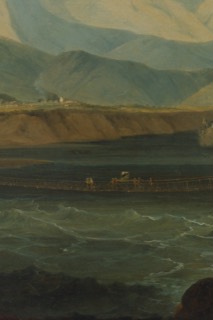
On Friday noon, July the twentieth, 1714, the finest bridge in all Peru broke and precipitated five travellers into the gulf below. This bridge was on the high road between Lima and Cuzco and hundreds of persons passed over it every day. It had been woven of osier by the Incas more than a century before, and visitors to the city were always led out to see it. It was a mere ladder of thin slats swung out over the gorge, with handrails of dried vine. Horses and coaches and chairs had to go down hundreds of feet below and pass over the narrow torrent on rafts, but no one, not even the Viceroy, not even the Archbishop of Lima, had descended with the baggage rather than cross by the famous bridge of San Luis Rey. St. Louis of France himself protected it, by his name and by the little mud church on the further side. The bridge seemed to be among the things that last forever; it was unthinkable that it should break. The moment a Peruvian heard of the accident he signed himself and made a mental calculation as to how recently he had crossed by it and how soon he had intended crossing by it again. People wandered about in a trance-like state, muttering; they had the hallucination of seeing themselves falling into a gulf.

There was a great service in the Cathedral. The bodies of the victims were approximately collected and approximately separated from one another, and there was great searching of hearts in the beautiful city of Lima.

Keep reading from here

Part Two: The Marquesa de Montemayor; Pepita

It is on this visit to the theatre that further matter hangs. She decided to go to the Comedia where the Perichole was playing Doña Leonor in Moreto’s Trampa Adelante; perhaps some material could be derived from the visit for her daughter’s next letter. She took with her Pepita, a little girl about whom later we shall learn much. Doña María had borrowed her to be her companion, from the orphanage connected with the Convent of Santa María Rosa de las Rosas. The Marquesa sat in her box gazing with flagging attention at the brilliant stage. Between the acts it was the Perichole’s custom to lay aside the courtly role and appear before the curtain to sing a few topical songs. The malicious actress had seen the Marquesa arrive and presently began improvising couplets alluding to her appearance, her avarice, her drunkenness, and even to her daughter’s flight from her. The attention of the house was subtly directed to the old woman, and a rising murmur of contempt accompanied the laughter of the audience. But the Marquesa, deeply moved by the first two acts of the comedy, scarcely saw the singer and sat staring before her, thinking about Spain. Camila Perichole became bolder and the air was electric with the hatred and glee of the crowd. At last Pepita plucked the Marquesa’s sleeve and whispered to her that they should go. As they left the box the house arose and burst into a roar of triumph; the Perichole flung herself into a frenzied dance, for she saw the manager at the back of the hall and knew that her salary had been increased.

Keep reading from here

Part Three: Esteban

One morning twin boys were discovered in the foundlings’ basket before the door of the Convent of Santa María Rosa de las Rosas. Names were found for them almost before the arrival of the wet-nurse, but the names were not as useful to them as our names are to most of us, for no one ever succeeded in telling the boys apart. There was no way of knowing who their parents were, but Limean gossips noticing as the boys grew older how straight they held themselves and how silent and sombre they were, declared them to be Castilian and laid them in turn at all sorts of crested doorways. The person in the world who came nearest to being their guardian was the Abbess of the Convent. Madre María del Pilar had come to hate all men, but she grew fond of Manuel and Esteban. In the late afternoon she would call them into her office, send for some cakes from the kitchen, and tell them stories about the Cid and Judas Maccabeus and the thirty-six misfortunes of Harlequin. She grew to love them so that she would catch herself gazing deep into their black and frowning eyes, looking for those traits that would appear when they grew to be men, all that ugliness, all that soullessness that made hideous the world she worked in.

Keep reading from here

Part Three: Esteban

One evening Manuel tore open the flesh on his knee against a piece of metal.

Neither brother had ever been ill for as much as a day in his life, and now Manuel, utterly bewildered, watched his leg swell and felt the waves of pain rise and fall in his body. Esteban sat by and stared at his face trying to imagine what great pain was. At last, one midnight, Manuel remembered that the signboard of a certain hairdresser in the city described the proprietor as an experienced barber and surgeon. Esteban ran through the streets to fetch him. He pounded on the door. Presently a woman leaned out of a window and announced that her husband would be back in the morning. During the fearful hours that followed, they told one another that when the doctor had seen the leg all would be well. He would do something about it, and Manuel would be out around the town in a day or two, even in a day perhaps, even less than a day.

The barber arrived and prescribed various draughts and ointments. Esteban was instructed to lay cold cloths on his brother’s leg every hour. The barber withdrew and the brothers sat down to wait for the pain to subside. But while they continued staring into one another’s faces waiting for the miracle of science, the pain grew worse. Hour after hour Esteban approached with his dripping towel and they discovered that the moment of its application was the worst of all.

Keep reading from here

Part Four: Uncle Pio; Don Jaime

Uncle Pio came of a good Castilian house, illegitimately. At the age of ten he ran away to Madrid from his father’s hacienda and was pursued without diligence. He lived ever after by his wits. He possessed the six attributes of the adventurer⁠—a memory for names and faces, with the aptitude for altering his own; the gift of tongues; inexhaustible invention; secrecy; the talent for falling into conversation with strangers; and that freedom from conscience that springs from a contempt for the dozing rich he preyed upon. From ten to fifteen he distributed handbills for merchants, held horses, and ran confidential errands. From fifteen to twenty he trained bears and snakes for travelling circuses; he cooked, and mixed punches; he hung about the entries of the most expensive taverns and whispered informations into the travellers’ ears⁠—sometimes nothing more dubious than that a certain noble house was reduced to selling its plate and could thus dispense with the commission of a silversmith. He was attached to all the theatres in town and could applaud like ten. He spread slanders at so much a slander. He sold rumors about crops and about the value of land. From twenty to thirty his services came to be recognized in very high circles⁠—he was sent out by the Government to inspirit some halfhearted rebellions in the mountains, so that the government could presently arrive and wholeheartedly crush them. His discretion was so profound that the French party used him even when they knew that the Austrian party used him also. He had long interviews with the Princesse des Ursins, but he came and went by the back stairs.

Keep reading from here

10 of the best lines

The bridge seemed to be among the things that last forever; it was unthinkable that it should break.

Part One: Perhaps an AccidentKeep reading from here

Either we live by accident and die by accident, or we live by plan and die by plan.

Part One: Perhaps an AccidentKeep reading from here

And I, who claim to know so much more, isn’t it possible that even I have missed the very spring within the spring?

Part One: Perhaps an AccidentKeep reading from here

Style is but the faintly contemptible vessel in which the bitter liquid is recommended to the world.

Part Two: The Marquesa de Montemayor; PepitaKeep reading from here

All the world was remote and strange and hostile except one’s brother.

Part Three: EstebanKeep reading from here

Now he discovered that secret from which one never quite recovers, that even in the most perfect love one person loves less profoundly than the other.

Part Three: EstebanKeep reading from here

The public for which masterpieces are intended is not on this earth.

Part Four: Uncle Pio; Don JaimeKeep reading from here

Many who have spent a lifetime in it can tell us less of love than the child that lost a dog yesterday.

Part Four: Uncle Pio; Don JaimeKeep reading from here

The art of biography is more difficult than is generally supposed.

Part Five: Perhaps an IntentionKeep reading from here

The Abbess looked at her closely.

Part Five: Perhaps an IntentionKeep reading from here

All 19 The Bridge of San Luis Rey quotes, with the words around each

Reviews

No reviews yet. Be the first, in the app.

Write a review in Doomreader

Contents

  1. Part One: Perhaps an Accident
  2. Part Two: The Marquesa de Montemayor; Pepita
  3. Part Three: Esteban
  4. Part Four: Uncle Pio; Don Jaime
  5. Part Five: Perhaps an Intention

Listen to The Bridge of San Luis Rey free

The Bridge of San Luis Rey as a free audiobook: Doomreader reads any book aloud, free, in your phone's or computer's own voice. Open the book and tap listen, at the speed you like, hands free.

Want a more natural voice? The AI voices read with AI credits.

Listen free in Doomreader

Download The Bridge of San Luis Rey free

The whole book as an EPUB file, free and legal, from Standard Ebooks. It opens in any ebook app, or read it here in Doomreader with nothing to install.

Download the EPUB (0.6 MB)

More by Thornton Wilder

More like The Bridge of San Luis Rey

About this edition

Text from Standard Ebooks. Standard Ebooks dedicate their edition to the public domain (CC0 1.0). Every passage and line on this page is the book's own words, checked against the text.