Doomreader

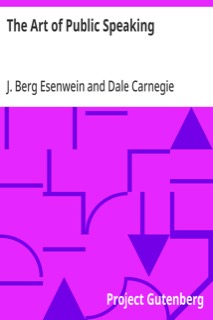
The Art of Public Speaking

by Dale Carnegie and J. Berg Esenwein

Length: 161,907 words, about 648 pages, about 11 hours to read

Business and work, Self-help

Read The Art of Public Speaking free, starting with its best pages and lines below. Listen to it free too, read aloud by your phone's own voice.

The best passages

Pages from the book itself, chosen to make you want to read on. Each opens in the reader at that exact spot.

ACQUIRING CONFIDENCE BEFORE AN AUDIENCE

to speak: after the inward fires of oratory are fanned into flame the eyes of the audience lose all terror.—William Pittenger, Extempore Speech.

Students of public speaking continually ask, "How can I overcome self-consciousness and the fear that paralyzes me before an audience?"

Did you ever notice in looking from a train window that some horses feed near the track and never even pause to look up at the thundering cars, while just ahead at the next railroad crossing a farmer's wife will be nervously trying to quiet her scared horse as the train goes by?

How would you cure a horse that is afraid of cars—graze him in a back-woods lot where he would never see steam-engines or automobiles, or drive or pasture him where he would frequently see the machines?

Apply horse-sense to ridding yourself of self-consciousness and fear: face an audience as frequently as you can, and you will soon stop shying. You can never attain freedom from stage-fright by reading a treatise. A book may give you excellent suggestions on how best to conduct yourself in the water, but sooner or later you must get wet, perhaps even strangle and be "half scared to death." There are a great many "wetless" bathing suits worn at the seashore, but no one ever learns to swim in them. To plunge is the only way.

Practise, practise, PRACTISE in speaking before an audience will tend to remove all fear of audiences, just as practise in swimming will lead to confidence and facility in the water. You must learn to speak by speaking.
Keep reading from here

PAUSE AND POWER

Suspense is responsible for a great share of our interest in life; it will be the same with your speech. A play or a novel is often robbed of much of its interest if you know the plot beforehand. We like to keep guessing as to the outcome. The ability to create suspense is part of woman's power to hold the other sex. The circus acrobat employs this principle when he fails purposely in several attempts to perform a feat, and then achieves it. Even the deliberate manner in which he arranges the preliminaries increases our expectation—we like to be kept waiting. In the last act of the play, "Polly of the Circus," there is a circus scene in which a little dog turns a backward somersault on the back of a running pony. One night when he hesitated and had to be coaxed and worked with a long time before he would perform his feat he got a great deal more applause than when he did his trick at once. We not only like to wait but we appreciate what we wait for. If fish bite too readily the sport soon ceases to be a sport.

It is this same principle of suspense that holds you in a Sherlock Holmes story—you wait to see how the mystery is solved, and if it is solved too soon you throw down the tale unfinished. Wilkie Collins' receipt for fiction writing well applies to public speech: "Make 'em laugh; make 'em weep; make 'em wait." Above all else make them wait; if they will not do that you may be sure they will neither laugh nor weep.

Keep reading from here

FEELING AND ENTHUSIASM

When traveling through the Northwest some time ago, one of the present writers strolled up a village street after dinner and noticed a crowd listening to a "faker" speaking on a corner from a goods-box. Remembering Emerson's advice about learning something from every man we meet, the observer stopped to listen to this speaker's appeal. He was selling a hair tonic, which he claimed to have discovered in Arizona. He removed his hat to show what this remedy had done for him, washed his face in it to demonstrate that it was as harmless as water, and enlarged on its merits in such an enthusiastic manner that the half-dollars poured in on him in a silver flood. When he had supplied the audience with hair tonic, he asked why a greater proportion of men than women were bald. No one knew. He explained that it was because women wore thinner-soled shoes, and so made a good electrical connection with mother earth, while men wore thick, dry-soled shoes that did not transmit the earth's electricity to the body. Men's hair, not having a proper amount of electrical food, died and fell out. Of course he had a remedy—a little copper plate that should be nailed on the bottom of the shoe. He pictured in enthusiastic and vivid terms the desirability of escaping baldness—and paid tributes to his copper plates. Strange as it may seem when the story is told in cold print, the speaker's enthusiasm had swept his audience with him, and they crushed around his stand with outstretched "quarters" in their anxiety to be the possessors of these magical plates!

Keep reading from here

THE TRUTH ABOUT GESTURE

You must not, however, begin at the wrong end: if you are troubled by your gestures, or a lack of gestures, attend to the cause, not the effect. It will not in the least help matters to tack on to your delivery a few mechanical movements. If the tree in your front yard is not growing to suit you, fertilize and water the soil and let the tree have sunshine. Obviously it will not help your tree to nail on a few branches. If your cistern is dry, wait until it rains; or bore a well. Why plunge a pump into a dry hole?

The speaker whose thoughts and emotions are welling within him like a mountain spring will not have much trouble to make gestures; it will be merely a question of properly directing them. If his enthusiasm for his subject is not such as to give him a natural impulse for dramatic action, it will avail nothing to furnish him with a long list of rules. He may tack on some movements, but they will look like the wilted branches nailed to a tree to simulate life. Gestures must be born, not built. A wooden horse may amuse the children, but it takes a live one to go somewhere.

Keep reading from here

AFTER-DINNER AND OTHER OCCASIONAL SPEAKING

The Rapidan suggests another scene to which allusion has often been made since the war, but which, as illustrative also of the spirit of both armies, I may be permitted to recall in this connection. In the mellow twilight of an April day the two armies were holding their dress parades on the opposite hills bordering the river. At the close of the parade a magnificent brass band of the Union army played with great spirit the patriotic airs, "Hail Columbia," and "Yankee Doodle." Whereupon the Federal troops responded with a patriotic shout. The same band then played the soul-stirring strains of "Dixie," to which a mighty response came from ten thousand Southern troops. A few moments later, when the stars had come out as witnesses and when all nature was in harmony, there came from the same band the old melody, "Home, Sweet Home." As its familiar and pathetic notes rolled over the water and thrilled through the spirits of the soldiers, the hills reverberated with a thundering response from the united voices of both armies. What was there in this old, old music, to so touch the chords of sympathy, so thrill the spirits and cause the frames of brave men to tremble with emotion? It was the thought of home. To thousands, doubtless, it was the thought of that Eternal Home to which the next battle might be the gateway.

Keep reading from here

10 of the best lines

You can never attain freedom from stage-fright by reading a treatise.

ACQUIRING CONFIDENCE BEFORE AN AUDIENCEKeep reading from here

Silence is one of the most eloquent things in the world.

PAUSE AND POWERKeep reading from here

The voice is a delicate instrument, and you must not handle it with hammer and tongs.

THE VOICEKeep reading from here

Thinking is doing mental arithmetic with facts.

THOUGHT AND RESERVE POWERKeep reading from here

Base your appeal on reason, but do not end in the basement—let the building rise, full of deep emotion and noble persuasion.

INFLUENCING BY PERSUASIONKeep reading from here

The freak memory is not worth striving for, but a good working memory decidedly is.

MEMORY TRAININGKeep reading from here

Conversation signifies in the original a turn-about exchange of ideas, yet most people seem to regard it as a monologue.

MAKING CONVERSATION EFFECTIVEKeep reading from here

The wisdom and energy of all the nations are none too great for the world work.

LAST SPEECHKeep reading from here

There is no human influence so potent for good as that which goes out from an upright life.

THE PRINCE OF PEACE[39]Keep reading from here

You don't need to go out of your own house to find out what to invent or what to make.

ACRES OF DIAMONDS[40]Keep reading from here

All 219 The Art of Public Speaking quotes, with the words around each

Reviews

No reviews yet. Be the first, in the app.

Write a review in Doomreader

Contents

All 174 parts
  1. J. BERG ESENWEIN
  2. DALE CARNAGEY
  3. PROFESSOR OF PUBLIC SPEAKING, BALTIMORE SCHOOL OF COMMERCE AND FINANCE; INSTRUCTOR IN PUBLIC SPEAKING, Y.M.C.A. SCHOOLS, NEW YORK, BROOKLYN, BALTIMORE, AND PHILADELPHIA, AND THE NEW YORK CITY CHAPTER, AMERICAN INSTITUTE OF BANKING
  4. THE WRITER'S LIBRARY
  5. THE HOME CORRESPONDENCE SCHOOL
  6. SPRINGFIELD, MASS.
  7. F. ARTHUR METCALF
  8. FELLOW-WORKER AND FRIEND
  9. THINGS TO THINK OF FIRST
  10. A FOREWORD
  11. CHAPTER I
  12. ACQUIRING CONFIDENCE BEFORE AN AUDIENCE
  13. QUESTIONS AND EXERCISES.
  14. CHAPTER II
  15. THE SIN OF MONOTONY
  16. QUESTIONS AND EXERCISES.
  17. CHAPTER III
  18. EFFICIENCY THROUGH EMPHASIS AND SUBORDINATION
  19. QUESTIONS AND EXERCISES
  20. CHAPTER IV
  21. EFFICIENCY THROUGH CHANGE OF PITCH
  22. QUESTIONS AND EXERCISES
  23. CHAPTER V
  24. EFFICIENCY THROUGH CHANGE OF PACE
  25. QUESTIONS AND EXERCISES
  26. FOOL'S GOLD
  27. EXERCISES
  28. THE MOB
  29. QUESTIONS AND EXERCISES
  30. A PLEA FOR CUBA
  31. CHAPTER VI
  32. PAUSE AND POWER
  33. QUESTIONS AND EXERCISES
  34. FOOTNOTES:
  35. CHAPTER VII
  36. EFFICIENCY THROUGH INFLECTION
  37. QUESTIONS AND EXERCISES
  38. SELECTIONS FOR PRACTISE
  39. THE HISTORY OF LIBERTY
  40. CHAPTER VIII
  41. CONCENTRATION IN DELIVERY
  42. QUESTIONS AND EXERCISES
  43. CHAPTER IX
  44. FORCE
  45. QUESTIONS AND EXERCISES
  46. FOOTNOTES:
  47. CHAPTER X
  48. FEELING AND ENTHUSIASM
  49. QUESTIONS AND EXERCISES
  50. PATRICK HENRY'S SPEECH
  51. BEFORE THE VIRGINIA CONVENTION OF DELEGATES
  52. CHAPTER XI
  53. FLUENCY THROUGH PREPARATION
  54. QUESTIONS AND EXERCISES
  55. GENERAL THEMES
  56. FOOTNOTES:
  57. CHAPTER XII
  58. THE VOICE
  59. QUESTIONS AND EXERCISES
  60. CHAPTER XIII
  61. VOICE CHARM
  62. SELECTIONS FOR PRACTISE
  63. FROM MILTON'S "L'ALLEGRO"
  64. THE SEA
  65. THE LARK
  66. THE BROOK
  67. QUESTIONS AND EXERCISES
  68. CHAPTER XIV
  69. DISTINCTNESS AND PRECISION OF UTTERANCE
  70. QUESTIONS AND EXERCISES
  71. FOOTNOTES:
  72. CHAPTER XV
  73. THE TRUTH ABOUT GESTURE
  74. QUESTIONS AND EXERCISES
  75. CHAPTER XVI
  76. METHODS OF DELIVERY
  77. QUESTIONS AND EXERCISES
  78. CHAPTER XVII
  79. THOUGHT AND RESERVE POWER
  80. QUESTIONS AND EXERCISES
  81. FOOTNOTES:
  82. CHAPTER XVIII
  83. QUESTIONS AND EXERCISES
  84. FOOTNOTES:
  85. CHAPTER XIX
  86. INFLUENCING BY EXPOSITION
  87. QUESTIONS AND EXERCISES
  88. FOOTNOTES:
  89. CHAPTER XX
  90. INFLUENCING BY DESCRIPTION
  91. FOOTNOTES:
  92. CHAPTER XXI
  93. INFLUENCING BY NARRATION
  94. QUESTIONS AND EXERCISES
  95. FOOTNOTES:
  96. CHAPTER XXII
  97. INFLUENCING BY SUGGESTION
  98. INVICTUS
  99. QUESTIONS AND EXERCISES
  100. CHAPTER XXIII
  101. INFLUENCING BY ARGUMENT
  102. QUESTIONS AND EXERCISES
  103. FOOTNOTES:
  104. CHAPTER XXIV
  105. INFLUENCING BY PERSUASION
  106. QUESTIONS AND EXERCISES
  107. CHAPTER XXV
  108. INFLUENCING THE CROWD
  109. FOOTNOTES:
  110. CHAPTER XXVI
  111. RIDING THE WINGED HORSE
  112. I. WHAT IS IMAGINATION?
  113. II. THE USES OF IMAGING IN PUBLIC SPEAKING
  114. III. HOW TO ACQUIRE THE IMAGING HABIT
  115. QUESTIONS AND EXERCISES
  116. FOOTNOTES:
  117. CHAPTER XXVII
  118. GROWING A VOCABULARY
  119. QUESTIONS AND EXERCISES
  120. FOOTNOTES:
  121. CHAPTER XXVIII
  122. MEMORY TRAINING
  123. QUESTIONS AND EXERCISES
  124. CHAPTER XXIX
  125. RIGHT THINKING AND PERSONALITY
  126. QUESTIONS AND EXERCISES
  127. CHAPTER XXX
  128. AFTER-DINNER AND OTHER OCCASIONAL SPEAKING
  129. QUESTIONS AND EXERCISES
  130. FOOTNOTES:
  131. CHAPTER XXXI
  132. MAKING CONVERSATION EFFECTIVE
  133. QUESTIONS AND EXERCISES
  134. APPENDICES
  135. APPENDIX A
  136. FIFTY QUESTIONS FOR DEBATE
  137. APPENDIX B
  138. THIRTY THEMES FOR SPEECHES
  139. APPENDIX C
  140. SUGGESTIVE SUBJECTS FOR SPEECHES[36]
  141. FOOTNOTES:
  142. APPENDIX D SPEECHES FOR STUDY AND PRACTISE NEWELL DWIGHT HILLIS
  143. BRAVE LITTLE BELGIUM
  144. HENRY WATTERSON
  145. THE NEW AMERICANISM
  146. JOHN MORLEY
  147. FOUNDER'S DAY ADDRESS
  148. ROBERT TOOMBS
  149. ON RESIGNING FROM THE SENATE, 1861
  150. THEODORE ROOSEVELT
  151. INAUGURAL ADDRESS
  152. ON AMERICAN MOTHERHOOD[38]
  153. ALTON B. PARKER
  154. THE CALL TO DEMOCRATS
  155. JOHN W. WESCOTT
  156. NOMINATING WOODROW WILSON
  157. HENRY W. GRADY
  158. THE RACE PROBLEM
  159. WILLIAM McKINLEY
  160. LAST SPEECH
  161. JOHN HAY
  162. TRIBUTE TO MCKINLEY
  163. WILLIAM JENNINGS BRYAN
  164. THE PRINCE OF PEACE[39]
  165. RUFUS CHOATE
  166. EULOGY OF WEBSTER
  167. ALBERT J. BEVERIDGE
  168. PASS PROSPERITY AROUND
  169. RUSSELL CONWELL
  170. ACRES OF DIAMONDS[40]
  171. VICTOR HUGO
  172. HONORE DE BALZAC
  173. FOOTNOTES:
  174. GENERAL INDEX

Listen to The Art of Public Speaking free

The Art of Public Speaking as a free audiobook: Doomreader reads any book aloud, free, in your phone's or computer's own voice. Open the book and tap listen, at the speed you like, hands free.

Want a more natural voice? The AI voices read with AI credits.

Listen free in Doomreader

Download The Art of Public Speaking free

The whole book as an EPUB file, free and legal, from Project Gutenberg. It opens in any ebook app, or read it here in Doomreader with nothing to install.

Download the EPUB (0.5 MB)

On a reading path

More like The Art of Public Speaking

About this edition

Text from Project Gutenberg. In the public domain in the USA. The Project Gutenberg License is kept inside the file. Every passage and line on this page is the book's own words, checked against the text.