Doomreader

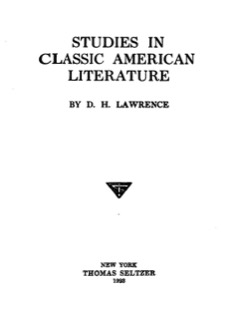
Studies in Classic American Literature

by D. H. Lawrence

Length: 62,458 words, about 250 pages, about 4 hours to read

Essays and ideas

Read Studies in Classic American Literature free, starting with its best pages and lines below. Listen to it free too, read aloud by your phone's own voice.

The best passages

Pages from the book itself, chosen to make you want to read on. Each opens in the reader at that exact spot.

I. THE SPIRIT OF PLACE

We like to think of the old-fashioned American classics as children's books. Just childishness, on our part.

The old American art-speech contains an alien quality, which belongs to the American continent and to nowhere else. But, of course, so long as we insist on reading the books as children's tales, we miss all that.

One wonders what the proper high-brow Romans of the third and fourth or later centuries read into the strange utterances of Lucretius or Apuleius or Tertullian, Augustine or Athanasius. The uncanny voice of Iberian Spain, the weirdness of old Carthage, the passion of Libya and North Africa; you may bet the proper old Romans never heard these at all. They read old Latin inference over the top of it, as we read old European inference over the top of Poe or Hawthorne.

It is hard to hear a new voice, as hard as it is to listen to an unknown language. We just don't listen. There is a new voice in the old American classics. The world has declined to hear it, and has blabbed about children's stories.

Why?—Out of fear. The world fears a new experience more than it fears anything. Because a new experience displaces so many old experiences.
Keep reading from here

II. BENJAMIN FRANKLIN

The Perfectibility of Man! Ah heaven, what a dreary theme! The perfectibility of the Ford car! The perfectibility of which man? I am many men. Which of them are you going to perfect? I am not a mechanical contrivance.

Education! Which of the various me's do you propose to educate, and which do you propose to suppress?

Anyhow I defy you. I defy you, oh society, to educate me or to suppress me, according to your dummy standards.

The ideal man! And which is he, if you please? Benjamin Franklin or Abraham Lincoln? The ideal man! Roosevelt or Porfirio Diaz?

There are other men in me, besides this patient ass who sits here in a tweed jacket. What am I doing, playing the patient ass in a tweed jacket? Who am I talking to? Who are you, at the other end of this patience?

Who are you? How many selves have you? And which of these selves do you want to be?

Is Yale College going to educate the self that is in the dark of you, or Harvard College?

The ideal self! Oh, but I have a strange and fugitive self shut out and howling like a wolf or a coyote under the ideal windows. See his red eyes in the dark? This is the self who is coming into his own.

The perfectibility of man, dear God! When every man as long as he remains alive is in himself a multitude of conflicting men. Which of these do you choose to perfect, at the expense of every other?

Keep reading from here

V. FENIMORE COOPER'S LEATHERSTOCKING NOVELS

The Prairie, like Pioneers, bears a good deal the stamp of actuality. It is a strange, splendid book, full of sense of doom. The figures of the great Kentuckian men, with their wolf-women, loom colossal on the vast prairie, as they camp with their wagons. These are different pioneers from Judge Temple. Lurid, brutal, tinged with the sinisterness of crime; these are the gaunt white men who push west, push on and on against the natural opposition of the continent. On towards a doom. Great wings of vengeful doom seem spread over the west, grim against the intruder. You feel them again in Frank Norris' novel, The Octopus. While in the West of Bret Harte there is a very devil in the air, and beneath him are sentimental self-conscious people being wicked and goody by evasion.

In The Prairie there is a shadow of violence and dark cruelty flickering in the air. It is the aboriginal demon hovering over the core of the continent. It hovers still, and the dread is still there.

Into such a prairie enters the huge figure of Ishmael, ponderous, pariah-like Ishmael and his huge sons and his were-wolf wife. With their wagons they roll on from the frontiers of Kentucky, like Cyclops into the savage wilderness. Day after day they seem to force their way into oblivion. But their force of penetration ebbs. They are brought to a stop. They recoil in the throes of murder and entrench themselves in isolation on a hillock in the midst of the prairie. There they hold out like demi-gods against the elements and the subtle Indian.

Keep reading from here

VIII. HAWTHORNE'S "BLITHEDALE ROMANCE"

Sin is a queer thing. It isn't the breaking of divine commandments. It is the breaking of one's own integrity.

For instance, the sin in Hester and Arthur Dimmesdale's case was a sin because they did what they thought it wrong to do. If they had really wanted to be lovers, and if they had had the honest courage of their own passion, there would have been no sin: even had the desire been only momentary.

But if there had been no sin, they would have lost half the fun, or more, of the game.

It was this very doing of the thing that they themselves believed to be wrong, that constituted the chief charm of the act. Man invents sin, in order to enjoy the feeling of being naughty. Also, in order to shift the responsibility for his own acts. A Divine Father tells him what to do. And man is naughty and doesn't obey. And then shiveringly, ignoble man lets down his pants for a flogging.

If the Divine Father doesn't bring on the flogging, in this life, then Sinful Man shiveringly awaits his whipping in the afterlife.

Bah, the Divine Father, like so many other Crowned Heads, has abdicated his authority. Man can sin as much as he likes.

There is only one penalty: the loss of his own integrity. Man should never do the thing he believes to be wrong. Because if he does, he loses his own singleness, wholeness, natural honour.

If you want to do a thing, you've either got to believe, sincerely, that it's your true nature to do this thing: or else you've got to let it alone.

Keep reading from here

X. HERMAN MELVILLE'S "TYPEE" AND "OMOO"

Three little quibbles: morality, cannibal sacrament, and stone axes. You must have a fly even in Paradisal ointment. And the first was a ladybird.

But Paradise. He insists on it. Paradise. He could even go stark naked, like before the Apple episode. And his Fayaway, a laughing little Eve, naked with him, and hankering after no apple of knowledge, so long as he would just love her when he felt like it. Plenty to eat, needing no clothes to wear, sunny, happy people, sweet water to swim in: everything a man can want. Then why wasn't he happy along with the savages?

Because he wasn't.

He grizzled in secret, and wanted to escape.

He even pined for Home and Mother, the two things he had run away from as far as ships would carry him. HOME and MOTHER. The two things that were his damnation.

Keep reading from here

10 of the best lines

It is hard to hear a new voice, as hard as it is to listen to an unknown language.

I. THE SPIRIT OF PLACEKeep reading from here

I am not a mechanical contrivance.

II. BENJAMIN FRANKLINKeep reading from here

But you can't cut the throat of an epoch. You've got to steal the life from it through several centuries.

II. BENJAMIN FRANKLINKeep reading from here

If only people would meet in their very selves, without wanting to put some idea over one another, or some ideal.

IV. FENIMORE COOPER'S WHITE NOVELSKeep reading from here

To know a living thing is to kill it.

VI. EDGAR ALLAN POEKeep reading from here

The human spirit, fixed in a lie, adhering to a lie, giving itself perpetually the lie.

VII. NATHANIEL HAWTHORNE AND "THE SCARLET LETTER"Keep reading from here

Only ideas are final, finite, static, and single.

IX. DANA'S "TWO YEARS BEFORE THE MAST"Keep reading from here

One cannot go back. It is one's destiny inside one.

X. HERMAN MELVILLE'S "TYPEE" AND "OMOO"Keep reading from here

And again, as a revelation of destiny the book is too deep even for sorrow. Profound beyond feeling.

XI. HERMAN MELVILLE'S "MOBY DICK"Keep reading from here

The soul passing unenhanced, passing on foot and being no more than itself.

XII. WHITMANKeep reading from here

All 181 Studies in Classic American Literature quotes, with the words around each

Reviews

No reviews yet. Be the first, in the app.

Write a review in Doomreader

Contents

  1. NEW YORK THOMAS SELTZER
  2. FOREWORD
  3. I. THE SPIRIT OF PLACE
  4. II. BENJAMIN FRANKLIN
  5. III. HECTOR ST. JOHN DE CRÈVECŒUR
  6. IV. FENIMORE COOPER'S WHITE NOVELS
  7. V. FENIMORE COOPER'S LEATHERSTOCKING NOVELS
  8. VI. EDGAR ALLAN POE
  9. VII. NATHANIEL HAWTHORNE AND "THE SCARLET LETTER"
  10. VIII. HAWTHORNE'S "BLITHEDALE ROMANCE"
  11. IX. DANA'S "TWO YEARS BEFORE THE MAST"
  12. X. HERMAN MELVILLE'S "TYPEE" AND "OMOO"
  13. XI. HERMAN MELVILLE'S "MOBY DICK"
  14. XII. WHITMAN

Listen to Studies in Classic American Literature free

Studies in Classic American Literature as a free audiobook: Doomreader reads any book aloud, free, in your phone's or computer's own voice. Open the book and tap listen, at the speed you like, hands free.

Want a more natural voice? The AI voices read with AI credits.

Listen free in Doomreader

Download Studies in Classic American Literature free

The whole book as an EPUB file, free and legal, from Project Gutenberg. It opens in any ebook app, or read it here in Doomreader with nothing to install.

Download the EPUB (0.2 MB)

More by D. H. Lawrence

More like Studies in Classic American Literature

About this edition

Text from Project Gutenberg. In the public domain in the USA. The Project Gutenberg License is kept inside the file. Every passage and line on this page is the book's own words, checked against the text.