Doomreader

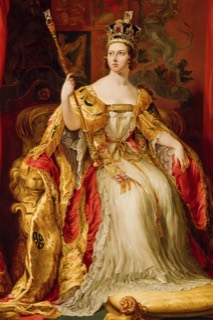
Queen Victoria

by Lytton Strachey

Length: 94,393 words, about 378 pages, about 7 hours to read

History and travel, Lives and letters

Read Queen Victoria free, starting with its best pages and lines below. Listen to it free too, read aloud by your phone's own voice.

What it is

A sardonic and generally unflattering biography of Victoria Alexandrina, Queen of England.

The best passages

Pages from the book itself, chosen to make you want to read on. Each opens in the reader at that exact spot.

Chapter I

On November 6, 1817, died the Princess Charlotte, only child of the Prince Regent, and heir to the crown of England. Her short life had hardly been a happy one. By nature impulsive, capricious, and vehement, she had always longed for liberty; and she had never possessed it. She had been brought up among violent family quarrels, had been early separated from her disreputable and eccentric mother, and handed over to the care of her disreputable and selfish father. When she was seventeen, he decided to marry her off to the Prince of Orange; she, at first, acquiesced; but, suddenly falling in love with Prince Augustus of Prussia, she determined to break off the engagement. This was not her first love affair, for she had previously carried on a clandestine correspondence with a Captain Hess. Prince Augustus was already married, morganatically, but she did not know it, and he did not tell her. While she was spinning out the negotiations with the Prince of Orange, the allied sovereign⁠—it was June, 1814⁠—arrived in London to celebrate their victory. Among them, in the suite of the Emperor of Russia, was the young and handsome Prince Leopold of Saxe-Coburg. He made several attempts to attract the notice of the Princess, but she, with her heart elsewhere, paid very little attention. Next month the Prince Regent, discovering that his daughter was having secret meetings with Prince Augustus, suddenly appeared upon the scene and, after dismissing her household, sentenced her to a strict seclusion in Windsor Park.
Keep reading from here

Chapter V

When all was over, the Archbishop and the Lord Chamberlain ordered a carriage, and drove posthaste from Windsor to Kensington. They arrived at the Palace at five o’clock, and it was only with considerable difficulty that they gained admittance. At six the Duchess woke up her daughter, and told her that the Archbishop of Canterbury and Lord Conyngham were there, and wished to see her. She got out of bed, put on her dressing-gown, and went, alone, into the room where the messengers were standing. Lord Conyngham fell on his knees, and officially announced the death of the King; the Archbishop added some personal details. Looking at the bending, murmuring dignitaries before her, she knew that she was Queen of England. “Since it has pleased Providence,” she wrote that day in her journal, “to place me in this station, I shall do my utmost to fulfil my duty towards my country; I am very young, and perhaps in many, though not in all things, inexperienced, but I am sure, that very few have more real good will and more real desire to do what is fit and right than I have.” But there was scant time for resolutions and reflections. At once, affairs were thick upon her. Stockmar came to breakfast, and gave some good advice. She wrote a letter to her uncle Leopold, and a hurried note to her sister Feodora. A letter came from the Prime Minister, Lord Melbourne, announcing his approaching arrival. He came at nine, in full court dress, and kissed her hand. She saw him alone, and repeated to him the lesson which, no doubt, the faithful Stockmar had taught her at breakfast.

Keep reading from here

Chapter IV

The day’s routine, whether in London or at Windsor, was almost invariable. The morning was devoted to business and Lord M. In the afternoon the whole Court went out riding. The Queen, in her velvet riding⁠—habit and a top-hat with a veil draped about the brim, headed the cavalcade; and Lord M. rode beside her. The lively troupe went fast and far, to the extreme exhilaration of Her Majesty. Back in the Palace again, there was still time for a little more fun before dinner⁠—a game of battledore and shuttlecock perhaps, or a romp along the galleries with some children. Dinner came, and the ceremonial decidedly tightened. The gentleman of highest rank sat on the right hand of the Queen; on her left⁠—it soon became an established rule⁠—sat Lord Melbourne. After the ladies had left the dining-room, the gentlemen were not permitted to remain behind for very long; indeed, the short time allowed them for their wine-drinking formed the subject⁠—so it was rumoured⁠—of one of the very few disputes between the Queen and her Prime Minister; but her determination carried the day, and from that moment after-dinner drunkenness began to go out of fashion. When the company was reassembled in the drawing-room the etiquette was stiff. For a few moments the Queen spoke in turn to each one of her guests; and during these short uneasy colloquies the aridity of royalty was apt to become painfully evident. One night Mr. Greville, the Clerk of the Privy Council, was present; his turn soon came; the middle-aged, hard-faced viveur was addressed by his young hostess. “Have you been riding today, Mr. Greville?” asked the Queen. “No, Madam, I have not,” replied Mr. Greville.

Keep reading from here

Chapter VII

Lord Melbourne replied with a very wise letter. He attempted to calm the Queen and to induce her to accept the new position gracefully; and he had nothing but good words for the Tory leaders. As for the question of the Ladies of the Household, the Queen, he said, should strongly urge what she desired, as it was a matter which concerned her personally, “but,” he added, “if Sir Robert is unable to concede it, it will not do to refuse and to put off the negotiation upon it.” On this point there can be little doubt that Lord Melbourne was right. The question was a complicated and subtle one, and it had never arisen before; but subsequent constitutional practice has determined that a Queen Regnant must accede to the wishes of her Prime Minister as to the personnel of the female part of her Household. Lord Melbourne’s wisdom, however, was wasted. The Queen would not be soothed, and still less would she take advice. It was outrageous of the Tories to want to deprive her of her Ladies, and that night she made up her mind that, whatever Sir Robert might say, she would refuse to consent to the removal of a single one of them. Accordingly, when, next morning, Peel appeared again, she was ready for action. He began by detailing the Cabinet appointments, and then he added “Now, ma’am, about the Ladies⁠—” when the Queen sharply interrupted him. “I cannot give up any of my Ladies,” she said. “What, ma’am!” said Sir Robert, “does your Majesty mean to retain them all?” “All,” said the Queen. Sir Robert’s face worked strangely; he could not conceal his agitation. “The Mistress of the Robes and the Ladies of the Bedchamber?” he brought out at last.

Keep reading from here

Chapter VI

With the final emergence of the Prince came the final extinction of Lord Melbourne. A year after his loss of office, he had been struck down by a paralytic seizure; he had apparently recovered, but his old elasticity had gone forever. Moody, restless, and unhappy, he wandered like a ghost about the town, bursting into soliloquies in public places, or asking odd questions, suddenly, à propos de bottes. “I’ll be hanged if I do it for you, my Lord,” he was heard to say in the hall at Brooks’s, standing by himself, and addressing the air after much thought. “Don’t you consider,” he abruptly asked a fellow-guest at Lady Holland’s, leaning across the dinner-table in a pause of the conversation, “that it was a most damnable act of Henri Quatre to change his religion with a view to securing the Crown?” He sat at home, brooding for hours in miserable solitude. He turned over his books⁠—his classics and his Testaments⁠—but they brought him no comfort at all. He longed for the return of the past, for the impossible, for he knew not what, for the devilries of Caro, for the happy platitudes of Windsor. His friends had left him, and no wonder, he said in bitterness⁠—the fire was out. He secretly hoped for a return to power, scanning the newspapers with solicitude, and occasionally making a speech in the House of Lords. His correspondence with the Queen continued, and he appeared from time to time at Court; but he was a mere simulacrum of his former self; “the dream,” wrote Victoria, “is past.” As for his political views, they could no longer be tolerated.

Keep reading from here

10 of the best lines

“They have made me tipsy,” she said.

Chapter IKeep reading from here

“As for the Bishops,” he burst out, “I positively believe they die to vex me.”

Chapter IIIKeep reading from here

“A vein of iron,” said Lady Lyttelton, who, as royal governess, had good means of observation, “runs through her most extraordinary character.”

Chapter IVKeep reading from here

The Victorian Age was in full swing.

Chapter VIKeep reading from here

“England,” he used to say, “is strong enough to brave consequences.”

Chapter IKeep reading from here

He believed that he was a failure and he began to despair.

Chapter IVKeep reading from here

“Dear me!” was his cynical comment. “I didn’t think she was so fond of them as that.”

Chapter IIKeep reading from here

If Victoria had died in the early seventies, there can be little doubt that the voice of the world would have pronounced her a failure.

Chapter IIKeep reading from here

She would not lose one memory or one pin.

Chapter IIIKeep reading from here

She moved through life with the imposing certitude of one to whom concealment was impossible⁠—either towards her surroundings or towards herself.

Chapter IVKeep reading from here

All 62 Queen Victoria quotes, with the words around each

Reviews

No reviews yet. Be the first, in the app.

Write a review in Doomreader

Contents

All 53 parts
  1. Foreword
  2. I: Antecedents
  3. Chapter I
  4. Chapter II
  5. Chapter III
  6. Chapter IV
  7. II: Childhood
  8. Chapter I
  9. Chapter II
  10. Chapter III
  11. Chapter IV
  12. Chapter V
  13. III: Lord Melbourne
  14. Chapter I
  15. Chapter II
  16. Chapter III
  17. Chapter IV
  18. Chapter V
  19. Chapter VI
  20. Chapter VII
  21. Chapter VIII
  22. IV: Marriage
  23. Chapter I
  24. Chapter II
  25. Chapter III
  26. Chapter IV
  27. Chapter V
  28. Chapter VI
  29. Chapter VII
  30. V: Lord Palmerston
  31. Chapter I
  32. Chapter II
  33. Chapter III
  34. VI: Last Years of Prince Consort
  35. Chapter I
  36. Chapter II
  37. Chapter III
  38. Chapter IV
  39. VII: Widowhood
  40. Chapter I
  41. Chapter II
  42. Chapter III
  43. Chapter IV
  44. VIII: Gladstone and Lord Beaconsfield
  45. Chapter I
  46. Chapter II
  47. Chapter III
  48. IX: Old Age
  49. Chapter I
  50. Chapter II
  51. Chapter III
  52. Chapter IV
  53. X: The End

Listen to Queen Victoria free

Queen Victoria as a free audiobook: Doomreader reads any book aloud, free, in your phone's or computer's own voice. Open the book and tap listen, at the speed you like, hands free.

Want a more natural voice? The AI voices read with AI credits.

Listen free in Doomreader

Download Queen Victoria free

The whole book as an EPUB file, free and legal, from Standard Ebooks. It opens in any ebook app, or read it here in Doomreader with nothing to install.

Download the EPUB (0.7 MB)

More by Lytton Strachey

More like Queen Victoria

About this edition

Text from Standard Ebooks. Standard Ebooks dedicate their edition to the public domain (CC0 1.0). Every passage and line on this page is the book's own words, checked against the text.