Doomreader

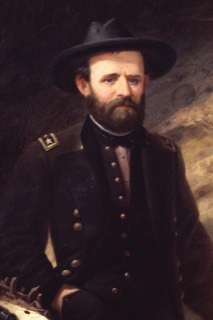
Personal Memoirs of Ulysses S. Grant

by Ulysses S. Grant

Length: 279,712 words, about 1,119 pages, about 20 hours to read

History and travel, Lives and letters

Read Personal Memoirs of Ulysses S. Grant free, starting with its best pages and lines below. Listen to it free too, read aloud by your phone's own voice.

What it is

One of the greatest generals of the United States tells the story of his life and details his key role in winning the Civil War.

The best passages

Pages from the book itself, chosen to make you want to read on. Each opens in the reader at that exact spot.

Chapter I

In June, 1821, my father, Jesse R. Grant, married Hannah Simpson. I was born on the 27th of April, 1822, at Point Pleasant, Clermont County, Ohio. In the fall of 1823 we moved to Georgetown, the county seat of Brown, the adjoining county east. This place remained my home, until at the age of seventeen, in 1839, I went to West Point.

The schools, at the time of which I write, were very indifferent. There were no free schools, and none in which the scholars were classified. They were all supported by subscription, and a single teacher⁠—who was often a man or a woman incapable of teaching much, even if they imparted all they knew⁠—would have thirty or forty scholars, male and female, from the infant learning the A.B.C.’s up to the young lady of eighteen and the boy of twenty, studying the highest branches taught⁠—the three R’s, “Reading, ’Riting, ’Rithmetic.” I never saw an algebra, or other mathematical work higher than the arithmetic, in Georgetown, until after I was appointed to West Point. I then bought a work on algebra in Cincinnati; but having no teacher it was Greek to me.

Keep reading from here

Chapter II

The conceit was knocked out of me by two little circumstances that happened soon after the arrival of the clothes, which gave me a distaste for military uniform that I never recovered from. Soon after the arrival of the suit I donned it, and put off for Cincinnati on horseback. While I was riding along a street of that city, imagining that everyone was looking at me, with a feeling akin to mine when I first saw General Scott, a little urchin, bareheaded, footed, with dirty and ragged pants held up by bare a single gallows⁠—that’s what suspenders were called then⁠—and a shirt that had not seen a washtub for weeks, turned to me and cried: “Soldier! will you work? No, sir⁠—ee; I’ll sell my shirt first!!” The horse trade and its dire consequences were recalled to mind.

The other circumstance occurred at home. Opposite our house in Bethel stood the old stage tavern where “man and beast” found accommodation. The stableman was rather dissipated, but possessed of some humor. On my return I found him parading the streets, and attending in the stable, barefooted, but in a pair of sky-blue nankeen pantaloons⁠—just the color of my uniform trousers⁠—with a strip of white cotton sheeting sewed down the outside seams in imitation of mine. The joke was a huge one in the mind of many of the people, and was much enjoyed by them; but I did not appreciate it so highly.

Keep reading from here

Chapter IV

After I had gone ashore, and had been on guard several days at Shell Island, quite six miles from the ship, I had occasion for some reason or other to return on board. While on the Suviah⁠—I think that was the name of our vessel⁠—I heard a tremendous racket at the other end of the ship, and much and excited sailor language, such as “damn your eyes,” etc. In a moment or two the captain, who was an excitable little man, dying with consumption, and not weighing much over a hundred pounds, came running out, carrying a sabre nearly as large and as heavy as he was, and crying, that his men had mutinied. It was necessary to sustain the captain without question, and in a few minutes all the sailors charged with mutiny were in irons. I rather felt for a time a wish that I had not gone aboard just then. As the men charged with mutiny submitted to being placed in irons without resistance, I always doubted if they knew that they had mutinied until they were told.

Keep reading from here

Chapter VII

While General Taylor was away with the bulk of his army, the little garrison up the river was besieged. As we lay in our tents upon the seashore, the artillery at the fort on the Rio Grande could be distinctly heard.

The war had begun.

There were no possible means of obtaining news from the garrison, and information from outside could not be otherwise than unfavorable. What General Taylor’s feelings were during this suspense I do not know; but for myself, a young second-lieutenant who had never heard a hostile gun before, I felt sorry that I had enlisted. A great many men, when they smell battle afar off, chafe to get into the fray. When they say so themselves they generally fail to convince their hearers that they are as anxious as they would like to make believe, and as they approach danger they become more subdued. This rule is not universal, for I have known a few men who were always aching for a fight when there was no enemy near, who were as good as their word when the battle did come. But the number of such men is small.

Keep reading from here

Chapter XXX

The news of the capture of Holly Springs and the destruction of our supplies caused much rejoicing among the people remaining in Oxford. They came with broad smiles on their faces, indicating intense joy, to ask what I was going to do now without anything for my soldiers to eat. I told them that I was not disturbed; that I had already sent troops and wagons to collect all the food and forage they could find for fifteen miles on each side of the road. Countenances soon changed, and so did the inquiry. The next was, “What are we to do?” My response was that we had endeavored to feed ourselves from our own northern resources while visiting them; but their friends in gray had been uncivil enough to destroy what we had brought along, and it could not be expected that men, with arms in their hands, would starve in the midst of plenty. I advised them to emigrate east, or west, fifteen miles and assist in eating up what we left.

Keep reading from here

10 of the best lines

“Man proposes and God disposes.” There are but few important events in the affairs of men brought about by their own choice.

PrefaceKeep reading from here

These are qualities more rarely found than genius or physical courage.

Chapter VIIKeep reading from here

Now, the right of revolution is an inherent one.

Chapter XVIKeep reading from here

Ifs defeated the Confederates at Shiloh.

Chapter XXVKeep reading from here

I slept that night in the room that Johnston was said to have occupied the night before.

Chapter XXXVKeep reading from here

The Secretary of War told me afterwards that he caught a cold on that occasion from which he never expected to recover. He never did.

Chapter XLKeep reading from here

No orders ever had to be given to establish the telegraph.

Chapter LIKeep reading from here

At all events I had not the heart to turn the artillery upon such a mass of defeated and fleeing men, and I hoped to capture them soon.

Chapter LXVKeep reading from here

But they were not willing to play the role of police for the South in the protection of this particular institution.

ConclusionKeep reading from here

Instead of retreating with his whole command on the main army, to tell the story of superior forces encountered, he deployed his cavalry on foot, leaving only mounted men enough to take charge of the horses.

Report of Lieutenant-General U. S. Grant, of the United States Armies 1864–65Keep reading from here

All 183 Personal Memoirs of Ulysses S. Grant quotes, with the words around each

Reviews

No reviews yet. Be the first, in the app.

Write a review in Doomreader

Contents

All 79 parts
  1. Preface
  2. Personal Memoirs of U. S. Grant
  3. Chapter I
  4. Chapter II
  5. Chapter III
  6. Chapter IV
  7. Chapter V
  8. Chapter VI
  9. Chapter VII
  10. Chapter VIII
  11. Chapter IX
  12. Chapter X
  13. Chapter XI
  14. Chapter XII
  15. Chapter XIII
  16. Chapter XIV
  17. Chapter XV
  18. Chapter XVI
  19. Chapter XVII
  20. Chapter XVIII
  21. Chapter XIX
  22. Chapter XX
  23. Chapter XXI
  24. Chapter XXII
  25. Chapter XXIII
  26. Chapter XXIV
  27. Chapter XXV
  28. Chapter XXVI
  29. Chapter XXVII
  30. Chapter XXVIII
  31. Chapter XXIX
  32. Chapter XXX
  33. Chapter XXXI
  34. Chapter XXXII
  35. Chapter XXXIII
  36. Chapter XXXIV
  37. Chapter XXXV
  38. Chapter XXXVI
  39. Chapter XXXVII
  40. Chapter XXXVIII
  41. Chapter XXXIX
  42. Chapter XL
  43. Chapter XLI
  44. Chapter XLII
  45. Chapter XLIII
  46. Chapter XLIV
  47. Chapter XLV
  48. Chapter XLVI
  49. Chapter XLVII
  50. Chapter XLVIII
  51. Chapter XLIX
  52. Chapter L
  53. Chapter LI
  54. Chapter LII
  55. Chapter LIII
  56. Chapter LIV
  57. Chapter LV
  58. Chapter LVI
  59. Chapter LVII
  60. Chapter LVIII
  61. Chapter LIX
  62. Chapter LX
  63. Chapter LXI
  64. Chapter LXII
  65. Chapter LXIII
  66. Chapter LXIV
  67. Chapter LXV
  68. Chapter LXVI
  69. Chapter LXVII
  70. Chapter LXVIII
  71. Chapter LXIX
  72. Chapter LXX
  73. Conclusion
  74. Appendix
  75. Report of Lieutenant-General U. S. Grant, of the United States Armies 1864–65
  76. Organization Charts—Union and Confederate
  77. Union Army on the Rapidan, May 5, 1864
  78. Confederate Army
  79. Maps

Listen to Personal Memoirs of Ulysses S. Grant free

Personal Memoirs of Ulysses S. Grant as a free audiobook: Doomreader reads any book aloud, free, in your phone's or computer's own voice. Open the book and tap listen, at the speed you like, hands free.

Want a more natural voice? The AI voices read with AI credits.

Listen free in Doomreader

Download Personal Memoirs of Ulysses S. Grant free

The whole book as an EPUB file, free and legal, from Standard Ebooks. It opens in any ebook app, or read it here in Doomreader with nothing to install.

Download the EPUB (73.3 MB)

More like Personal Memoirs of Ulysses S. Grant

About this edition

Text from Standard Ebooks. Standard Ebooks dedicate their edition to the public domain (CC0 1.0). Every passage and line on this page is the book's own words, checked against the text.