Doomreader

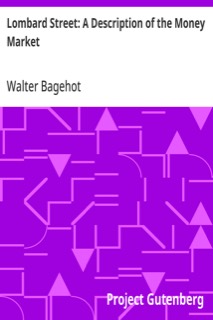
Lombard Street

by Walter Bagehot

Length: 82,467 words, about 330 pages, about 6 hours to read

Money and investing, Economics

Read Lombard Street free, starting with its best pages and lines below. Listen to it free too, read aloud by your phone's own voice.

The best passages

Pages from the book itself, chosen to make you want to read on. Each opens in the reader at that exact spot.

CHAPTER I.

Introductory.

I venture to call this Essay 'Lombard Street,' and not the 'Money Market,' or any such phrase, because I wish to deal, and to show that I mean to deal, with concrete realities. A notion prevails that the Money Market is something so impalpable that it can only be spoken of in very abstract words, and that therefore books on it must always be exceedingly difficult. But I maintain that the Money Market is as concrete and real as anything else; that it can be described in as plain words; that it is the writer's fault if what he says is not clear. In one respect, however, I admit that I am about to take perhaps an unfair advantage. Half, and more than half, of the supposed 'difficulty' of the Money Market has arisen out of the controversies as to 'Peel's Act,' and the abstract discussions on the theory on which that act is based, or supposed to be based. But in the ensuing pages I mean to speak as little as I can of the Act of 1844; and when I do speak of it, I shall deal nearly exclusively with its experienced effects, and scarcely at all, if at all, with its refined basis.
Keep reading from here

CHAPTER I.

But in exact proportion to the power of this system is its delicacy I should hardly say too much if I said its danger. Only our familiarity blinds us to the marvellous nature of the system. There never was so much borrowed money collected in the world as is now collected in London. Of the many millions in Lombard street, infinitely the greater proportion is held by bankers or others on short notice or on demand; that is to say, the owners could ask for it all any day they please: in a panic some of them do ask for some of it. If any large fraction of that money really was demanded, our banking system and our industrial system too would be in great danger.

Some of those deposits too are of a peculiar and very distinct nature. Since the Franco-German war, we have become to a much larger extent than before the Bankers of Europe. A very large sum of foreign money is on various accounts and for various purposes held here. And in a time of panic it might be asked for. In 1866 we held only a much smaller sum of foreign money, but that smaller sum was demanded and we had to pay it at great cost and suffering, and it would be far worse if we had to pay the greater sums we now hold, without better resources than we had then.

Keep reading from here

Chapter II

What then ought to be done?

In opposition to what might be at first sight supposed, the best way for the bank or banks who have the custody of the bank reserve to deal with a drain arising from internal discredit, is to lend freely. The first instinct of everyone is the contrary. There being a large demand on a fund which you want to preserve, the most obvious way to preserve it is to hoard it—to get in as much as you can, and to let nothing go out which you can help. But every banker knows that this is not the way to diminish discredit. This discredit means, 'an opinion that you have not got any money,' and to dissipate that opinion, you must, if possible, show that you have money: you must employ it for the public benefit in order that the public may know that you have it. The time for economy and for accumulation is before. A good banker will have accumulated in ordinary times the reserve he is to make use of in extraordinary times.

Keep reading from here

Chapter II

Of all institutions in the world the Bank of England is now probably the most remote from party politics and from 'financing.' But in its origin it was not only a finance company, but a Whig finance company. It was founded by a Whig Government because it was in desperate want of money, and supported by the 'City' because the 'City' was Whig. Very briefly, the story was this. The Government of Charles II. (under the Cabal Ministry) had brought the credit of the English State to the lowest possible point. It had perpetrated one of those monstrous frauds, which are likewise gross blunders. The goldsmiths, who then carried on upon a trifling scale what we should now call banking, used to deposit their reserve of treasure in the 'Exchequer,' with the sanction and under the care of the Government. In many European countries the credit of the State had been so much better than any other credit, that it had been used to strengthen the beginnings of banking. The credit of the state had been so used in England: though there had lately been a civil war and several revolutions, the honesty of the English Government was trusted implicitly. But Charles II. showed that it was trusted undeservedly. He shut up the 'Exchequer,' would pay no one, and so the 'goldsmiths' were ruined.

Keep reading from here

CHAPTER VII.

The matter would come shortly to this: a great number of brokers and dealers are under obligations to pay immense sums, and in common times they obtain these sums by the transfer of certain securities. If, as we said just now, No. 1 has borrowed 50,000 L. of No. 2 on Exchequer bills, he, for the most part, cannot pay No. 2 till he has sold or pledged those bills to some one else. But till he has the bills he cannot pledge or sell them; and if No. 2 will not give them up till he gets his money, No. 1 will be ruined, because he cannot pay it. And if No. 2 has No. 3 to pay, as is very likely, he may be ruined because of No. 1's default, and No. 4 only on account of No. 3's default; and so on without end. On settling day, without the Clearing-house, there would be a mass of failures, and a bundle of securities. The effect of these failures would be a general run on all bankers, and on the Bank of England particularly.

Keep reading from here

10 of the best lines

But I maintain that the Money Market is as concrete and real as anything else; that it can be described in as plain words; that it is the writer's fault if what he says is not clear.

CHAPTER I.Keep reading from here

Commerce is curiously conservative in its homes, unless it is imperiously obliged to migrate.

CHAPTER I.Keep reading from here

But still there is a faith in the Bank, contrary to experience, and despising evidence.

CHAPTER II.Keep reading from here

Very large loans at very high rates are the best remedy for the worst malady of the money market when a foreign drain is added to a domestic drain.

Chapter IIKeep reading from here

The Government had created a machinery of ruin, and had thriven on it.

CHAPTER III.Keep reading from here

So long as such sales can be effected the mania continues; when it ceases to be possible to effect them, ruin begins.

CHAPTER VI.Keep reading from here

The abstract thinking of the world is never to be expected from persons in high places; the administration of first-rate current transactions is a most engrossing business, and those charged with them are usually but little inclined to think on points of theory, even when such thinking most nearly concerns those transactions.

CHAPTER VII.Keep reading from here

The fixed manager ensures continuity and experience in the management, and a good board of directors ensures general wisdom.

CHAPTER VIII.Keep reading from here

The world has become so large and complicated that it is not easy to ascertain who is rich and who is poor.

CHAPTER X.Keep reading from here

Too much reserve only means a small loss of profit, but too small a reserve may mean 'ruin.'

CHAPTER XII.Keep reading from here

All 86 Lombard Street quotes, with the words around each

Reviews

No reviews yet. Be the first, in the app.

Write a review in Doomreader

Contents

  1. CHAPTER I.
  2. CHAPTER II.
  3. Chapter II
  4. CHAPTER III.
  5. Chapter II
  6. CHAPTER IV.
  7. CHAPTER V.
  8. CHAPTER VI.
  9. CHAPTER VII.
  10. CHAPTER VIII.
  11. CHAPTER IX.
  12. CHAPTER X.
  13. CHAPTER XI.
  14. CHAPTER XII.
  15. CHAPTER XIII.
  16. APPENDIX.

Listen to Lombard Street free

Lombard Street as a free audiobook: Doomreader reads any book aloud, free, in your phone's or computer's own voice. Open the book and tap listen, at the speed you like, hands free.

Want a more natural voice? The AI voices read with AI credits.

Listen free in Doomreader

Download Lombard Street free

The whole book as an EPUB file, free and legal, from Project Gutenberg. It opens in any ebook app, or read it here in Doomreader with nothing to install.

Download the EPUB (0.3 MB)

On a reading path

More by Walter Bagehot

More like Lombard Street

About this edition

Text from Project Gutenberg. In the public domain in the USA. The Project Gutenberg License is kept inside the file. Every passage and line on this page is the book's own words, checked against the text.