Doomreader

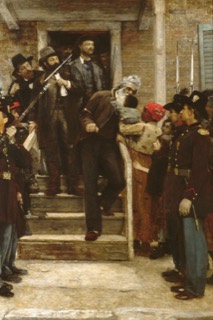
John Brown’s Body

by Stephen Vincent Benét

Length: 102,957 words, about 412 pages, about 7 hours to read

Poetry

Read John Brown’s Body free, starting with its best pages and lines below. Listen to it free too, read aloud by your phone's own voice.

What it is

The sweeping tragedy of the American Civil War is chronicled through the interwoven experiences of soldiers and civilians from both the North and the South.

The best passages

Pages from the book itself, chosen to make you want to read on. Each opens in the reader at that exact spot.

Prelude

Prelude The Slaver

He closed the Bible carefully, putting it down As if his fingers loved it. Then he turned. “Mr. Mate.” “Yes, sir.” The captain’s eyes held a shadow. “I think, while this weather lasts,” he said, after a pause, “We’d better get them on deck as much as we can. They keep better that way. Besides,” he added, unsmiling, “She’s begun to stink already. You’ve noticed it?”

The mate nodded, a boyish nod of half-apology, “And only a week out, too, sir.” “Yes,” said the skipper. His eyes looked into themselves. “Well. The trade,” he said, “The trade’s no damn perfume-shop.” He drummed with his fingers. “Seem to be quiet tonight,” he murmured at last. “Oh yes sir, quiet enough.” The mate flushed. “Not What you’d call quiet at home but⁠—quiet enough.”

“Um,” said the skipper. “What about the big fellow?”

“Tarbarrel, sir? The man who says he’s a king? He was praying to something⁠—it made the others restless. Mr. Olsen stopped it.” “I don’t like that,” said the skipper. “It was only an idol, sir.” “Oh.” “A stone or something.” “Oh.” “But he’s a bad one, sir⁠—a regular sullen one⁠— He⁠—eyes in the dark⁠—like a cat’s⁠—enough to give you⁠—” The mate was young. He shivered. “The creeps,” he said.

“We’ve had that kind,” said the skipper. His mouth was hard Then it relaxed. “Damn cheating Arabe!” he said, “I told them I’d take no more of their pennyweight kings, Worth pounds to look at, and then when you get them aboard Go crazy so they have to be knocked on the head Or else just eat up their hearts and die in a week Taking up room for nothing.”
Keep reading from here

Book I

Jack Ellyat had been out all day alone, Except for his new gun and Ned, the setter, The old wise dog with Autumn in his eyes, Who stepped the fallen leaves so delicately They barely rustled. Ellyat trampled them down Crackling, like cast-off skins of fairy snakes. He’d meant to hunt, but he had let the gun Rest on his shoulder. It was enough to feel The cool air of the last of Indian summer Blowing continually across his cheek And watch the light distill its water of gold As the sun dropped. Here was October, here Was ruddy October, the old harvester, Wrapped like a beggared sachem in a coat Of tattered tanager and partridge feathers, Scattering jack-o-lanterns everywhere To give the field-mice pumpkin-colored moons. His red clay pipe had trailed across the land Staining the trees with colors of the sumach: East, West, South, North, the ceremonial fume Blue and enchanted as the soul of air Drifted its incense. Incense of the wild, Incense of earth fulfilled, ready to sleep The stupefied dark slumber of the bear All winter, underneath a frozen star. Jack Ellyat felt that turning of the year Stir in his blood like drowsy fiddle-music And knew he was glad to be Connecticut-born And young enough to find Connecticut winter Was a black pond to cut with silver skates And not a scalping-knife against the throat. He thought the thoughts of youth, idle and proud.

Keep reading from here

Book II

Carter, the telegraph-operator, sighed And propped his eyes awake again. He was tired. Dog-tired, stone-tired, body and mind burnt up With too much poker last night and too little sleep. He hated the Sunday trick. It was Riley’s turn To take it, but Riley’s wife was having a child. He cursed the child and the wife and Sunday and Riley. Nothing ever happened at Stroudsburg Siding And yet he had to be here and keep awake With the flat, stale taste of too little sleep in his mouth And wait for nothing to happen. His bulky body Lusted for sleep with every muscle and nerve. He’d rather have sleep than a woman or whiskey or money. He’d give up the next three women that might occur For ten minutes’ sleep, he’d never play poker again, He’d⁠—battered face beginning to droop on his hands⁠— Sleep⁠—women⁠—whiskey⁠—eyelids too heavy to lift⁠— “Yes, Ma, I said, ‘Now I lay me.’ ”⁠— The sounder chattered And his head snapped back with a sharp, neck-breaking jerk. By God, he’d nearly⁠—chat⁠—chitter-chatter-chat-chat⁠— For a moment he took it in without understanding And then the vein in his forehead began to swell And his eyes bulged wide awake. “By Jesus!” he said, And stared at the sounder as if it had turned to a snake. “By Jesus!” he said, “By Jesus, they’ve done it!” he said.

Keep reading from here

Book II

Luke Breckinridge, his rifle on his shoulder, Slipped through green forest alleys toward the town, A gawky boy with smoldering eyes, whose feet Whispered the crooked paths like moccasins. He wasn’t looking for trouble, going down, But he was on guard, as always. When he stopped To scoop some water in the palm of his hand From a sweet trickle between moss-grown rocks, You might have thought him careless for a minute, But when the snapped stick cracked six feet behind him He was all sudden rifle and hard eyes. The pause endured a long death-quiet instant, Then he knew who it was. “Hi, Jim,” he said, Lowering his rifle. The green laurel-screen Hardly had moved, but Jim was there beside him. The cousins looked at each other. Their rifles seemed To look as well, with much the same taut silentness.

“Goin’ to town, Luke?” “Uh-huh, goin’ to town, You goin’?” “Looks as if I was goin’.” “Looks As if you was after squirrels.” “I might be. You goin’ after squirrels?” “I might be, too.” “Not so many squirrels near town.” “No, reckon there’s not.”

Jim hesitated. His gaunt hands caressed The smooth guard of his rifle. His eyes were sharp. “Might go along a piece together,” he said. Luke didn’t move. Their eyes clashed for a moment, Then Luke spoke, casually. “I hear the Kelceys Air goin’ to fight in this here war,” he said. Jim nodded slowly, “Yuh, I heerd that too.” He watched Luke’s trigger-hand. “I might be goin’ Myself sometime,” he said reflectively Sliding his own hand down. Luke saw the movement. “We-uns don’t like the Kelceys much,” he said With his eyes down to pinpoints. Then Jim smiled. “We-uns neither,” he said. His hand slid back.

Keep reading from here

Book IV

The slave got away from Zachary’s place that night. He was a big fellow named Spade with one cropped ear. He had splay feet and sometimes walked with a limp. His back was scarred. He was black as a pine at night. He’d tried to run away a couple of times —That was how he got some of the marks you could tell him by⁠— But he’d been pretty quiet now for a year or so And they thought he had settled down. When he got away He meant to kill Zachary first but the signs weren’t right. He talked to the knife but the knife didn’t sweat or heat, So he just got away instead. When he reached the woods And was all alone, he was pretty scared for a while, But he kept on going all night by the big soft stars, Loping as fast as he could on his long splay feet And when morning broke, he knew he was safe for a time.

He came out on a cleared place, then. He saw the red Sun spill over the trees. He threw his pack Down on the ground and started to laugh and laugh, “Spade, boy, Spade, you’s lucky to git dis far. You never managed to git dis far before, De Lawd’s sho’ly with you, Spade.” He ate and drank. He drew a circle for Zachary’s face in the ground And spat in the circle. Then he thought of his woman. “She’s sho’ly a grievin’ woman dis mawnin’, Spade.” The thought made him sad at first, but he soon cheered up. “She’ll do all right as soon as she’s thu with grievin’. Grievin’ yaller gals always does all right.

Keep reading from here

10 of the best lines

They tried to fit you with an English song

InvocationKeep reading from here

The law’s our yardstick, and it measures well Or well enough when there are yards to measure.

Book IKeep reading from here

The science of war is moving live men like blocks.

Book IIKeep reading from here

We cannot talk to you still, as we used to, about the dead.)

Book IVKeep reading from here

The heart he kept himself, that answers all.

Book IVKeep reading from here

And after twenty thousand wasted strokes

Book VKeep reading from here

It seems strange that such tidy files

Book VKeep reading from here

He is a man with a knotty club in his hand

Book VIIKeep reading from here

Feet going on through the dust and the sallow mud, Feet going on forever⁠—

Book VIIIKeep reading from here

The world I knew is a long time dead.

Book VIIIKeep reading from here

All 85 John Brown’s Body quotes, with the words around each

Reviews

No reviews yet. Be the first, in the app.

Write a review in Doomreader

Contents

  1. Note
  2. Invocation
  3. Prelude
  4. Book I
  5. Book II
  6. Book III
  7. Book IV
  8. Book V
  9. Book VI
  10. Book VII
  11. Book VIII

Listen to John Brown’s Body free

John Brown’s Body as a free audiobook: Doomreader reads any book aloud, free, in your phone's or computer's own voice. Open the book and tap listen, at the speed you like, hands free.

Want a more natural voice? The AI voices read with AI credits.

Listen free in Doomreader

Download John Brown’s Body free

The whole book as an EPUB file, free and legal, from Standard Ebooks. It opens in any ebook app, or read it here in Doomreader with nothing to install.

Download the EPUB (1.2 MB)

More like John Brown’s Body

About this edition

Text from Standard Ebooks. Standard Ebooks dedicate their edition to the public domain (CC0 1.0). Every passage and line on this page is the book's own words, checked against the text.