Doomreader

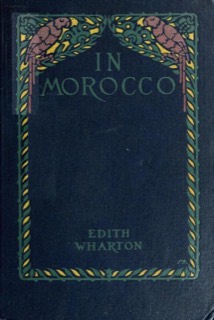
In Morocco

by Edith Wharton

Length: 52,253 words, about 209 pages, about 4 hours to read

History and travel

Read In Morocco free, starting with its best pages and lines below. Listen to it free too, read aloud by your phone's own voice.

The best passages

Pages from the book itself, chosen to make you want to read on. Each opens in the reader at that exact spot.

I LEAVING TANGIER

To step on board a steamer in a Spanish port, and three hours later to land in a country without a guide-book, is a sensation to rouse the hunger of the repletest sight-seer.

The sensation is attainable by any one who will take the trouble to row out into the harbour of Algeciras and scramble onto a little black boat headed across the straits. Hardly has the rock of Gibraltar turned to cloud when one's foot is on the soil of an almost unknown Africa. Tangier, indeed, is in the guide-books; but, cuckoo-like, it has had to lays its egg in strange nests, and the traveller who wants to find out about it must acquire a work dealing with some other country—Spain or Portugal or Algeria. There is no guide-book to Morocco, and no way of knowing, once one has left Tangier behind, where the long trail over the Rif is going to land one, in the sense understood by any one accustomed to European certainties. The air of the unforeseen blows on one from the roadless passes of the Atlas.

This feeling of adventure is heightened by the contrast between Tangier—cosmopolitan, frowsy, familiar Tangier, that every tourist has visited for the last forty years—and the vast unknown just beyond.
Keep reading from here

III EL-KSAR TO RABAT

Luncheon over, we hurry on between the cactus hedges, and then plunge back into the waste. Beyond El-Ksar the last hills of the Rif die away, and there is a stretch of wilderness without an outline till the Lesser Atlas begins to rise in the east. Once in the French protectorate the trail improves, but there are still difficult bits; and finally, on a high plateau, the chauffeur stops in a web of crisscross trails, throws up his hands, and confesses that he has lost his way. The heat is mortal at the moment. For the last hour the red breath of the sirocco has risen from every hollow into which we dipped; now it hangs about us in the open, as if we had caught it in our wheels and it had to pause above us when we paused.

All around is the featureless wild land, palmetto scrub stretching away into eternity. A few yards off rises the inevitable ruined koubba[2] with its fig-tree: in the shade under its crumbling wall the buzz of the flies is like the sound of frying. Farther off, we discern a cluster of huts, and presently some Arab boys and a tall pensive shepherd come hurrying across the scrub. They are full of good-will, and no doubt of information; but our chauffeur speaks no Arabic and the talk dies down into shrugs and head-shakings. The Arabs retire to the shade of the wall, and we decide to start—for anywhere....

Keep reading from here

II MOULAY IDRISS

Such a possibility had not occurred to us, and even Captain de M. seemed to doubt whether the expedition were advisable. Moulay Idriss was still said to be resentful of Christian intrusion: it was only a year before that the first French officers had entered it.

But M. Châtelain was confident that there would be no opposition to our visit, and with the piled-up terraces and towers of the Sacred City growing golden in the afternoon light across the valley it was impossible to hesitate.

We drove down through an olive-wood as ancient as those of Mitylene and Corfu, and then along the narrowing valley, between gardens luxuriant even in the parched Moroccan autumn. Presently the motor began to climb the steep road to the town, and at a gateway we got out and were met by the native chief of police. Instantly at the high windows of mysterious houses veiled heads appeared and sidelong eyes cautiously inspected us. But the quarter was deserted, and we walked on without meeting any one to the Street of the Weavers, a silent narrow way between low whitewashed niches like the cubicles in a convent. In each niche sat a grave white-robed youth, forming a great amphora-shaped grain-basket out of closely plaited straw. Vine-leaves and tendrils hung through the reed roofing overhead, and grape-clusters cast their classic shadow at our feet. It was like walking on the unrolled frieze of a white Etruscan vase patterned with black vine garlands.

Keep reading from here

V ON THE ROOFS

Suddenly, as we stood watching the extraordinary animation of the scene, a reddish light overspread it, and one of our companions exclaimed: "Ah—a dust-storm!"

In that very moment it was upon us: a red cloud rushing across the square out of nowhere, whirling the date-branches over the heads of the squatting throngs, tumbling down the stacks of fruits and vegetables, rooting up the canvas awnings over the lemonade-sellers' stalls and before the café doors, huddling the blinded donkeys under the walls of the fondak, and stripping to the hips the black slave-girls scudding home from the souks.

Such a blast would instantly have scattered any western crowd, but "the patient East" remained undisturbed, rounding its shoulders before the storm and continuing to follow attentively the motions of the dancers and the turns of the story-tellers. By and bye, however, the gale grew too furious, and the spectators were so involved in collapsing tents, eddying date-branches and stampeding mules that the square began to clear, save for the listeners about the most popular story-teller, who continued to sit on unmoved. And then, at the height of the storm, they too were abruptly scattered by the rush of a cavalcade across the square. First came a handsomely dressed man, carrying before him on his peaked saddle a tiny boy in a gold-embroidered orange caftan, in front of whom he held an open book; and behind them a train of white-draped men on showily harnessed mules, followed by musicians in bright dresses.

Keep reading from here

10 of the best lines

To step on board a steamer in a Spanish port, and three hours later to land in a country without a guide-book, is a sensation to rouse the hunger of the repletest sight-seer.

I LEAVING TANGIERKeep reading from here

Within the walls, the magic persists: which does not always happen when one penetrates into the mirage-like cities of Arabian Africa.

V ROBINSON CRUSOE'S "SALLEE"Keep reading from here

The officer remarked cheerfully that somebody might turn up, and we all sat down in the bled.

I VOLUBILISKeep reading from here

To touch the past with one's hands is realized only in dreams; and in Morocco the dream-feeling envelopes one at every step.

II FEZ ELDJIDKeep reading from here

Color and laughter lie mostly along the trade-routes, where the peoples of the world come and go in curiosity and rivalry.

V MEDERSAS, BAZAARS AND AN OASISKeep reading from here

The Giralda watched over civilized enemies in a land of ancient Roman culture; the Koutoubya stood at the edge of the world, facing the hordes of the desert.

II THE BAHIAKeep reading from here

As swiftly as it rose the storm subsided, leaving the fruit-market in ruins under a sky as clear and innocent as an infant's eye.

V ON THE ROOFSKeep reading from here

Then, at the turn of a commonplace street, one comes upon it suddenly.

IV IN OLD RABATKeep reading from here

Everywhere behind the bristling walls and rock-clamped towers of old Morocco lurks the shadowy spirit of instability.

I THE BERBERSKeep reading from here

The Merinid tombs of Fez have fallen; but those of their destroyers linger on in precarious grace, like a flower on the edge of a precipice.

Chapter IIIKeep reading from here

All 56 In Morocco quotes, with the words around each

Reviews

No reviews yet. Be the first, in the app.

Write a review in Doomreader

Contents

All 82 parts
  1. ILLUSTRATED
  2. PREFACE
  3. Chapter I
  4. Chapter II
  5. NOTE
  6. Chapter I
  7. RABAT AND SALÉ
  8. I LEAVING TANGIER
  9. II THE TRAIL TO EL-KSAR
  10. III EL-KSAR TO RABAT
  11. IV THE KASBAH OF THE OUDAYAS
  12. V ROBINSON CRUSOE'S "SALLEE"
  13. VI CHELLA AND THE GREAT MOSQUE
  14. FOOTNOTES:
  15. Chapter II
  16. VOLUBILIS, MOULAY IDRISS AND MEKNEZ
  17. I VOLUBILIS
  18. II MOULAY IDRISS
  19. III MEKNEZ
  20. FOOTNOTES:
  21. Chapter III
  22. FEZ
  23. I THE FIRST VISION
  24. II FEZ ELDJID
  25. III FEZ ELBALI
  26. IV EL ANDALOUS AND THE POTTERS' FIELD
  27. V MEDERSAS, BAZAARS AND AN OASIS
  28. VI THE LAST GLIMPSE
  29. FOOTNOTES:
  30. Chapter IV
  31. MARRAKECH
  32. I THE WAY THERE
  33. II THE BAHIA
  34. III THE BAZAARS
  35. IV THE AGDAL
  36. V ON THE ROOFS
  37. VI THE SAADIAN TOMBS
  38. FOOTNOTES:
  39. Chapter V
  40. HAREMS AND CEREMONIES
  41. I THE CROWD IN THE STREET
  42. II AÏD-EL-KEBIR
  43. III THE IMPERIAL MIRADOR
  44. IV IN OLD RABAT
  45. V IN FEZ
  46. VI IN MARRAKECH
  47. FOOTNOTES:
  48. Chapter VI
  49. GENERAL LYAUTEY'S WORK IN MOROCCO
  50. Chapter I
  51. Chapter II
  52. Chapter III
  53. THE WORK OF THE FRENCH PROTECTORATE, 1912-1918 PORTS
  54. COMMERCE COMPARATIVE TABLES
  55. ROADS BUILT
  56. RAILWAYS BUILT
  57. LAND CULTIVATED
  58. JUSTICE
  59. EDUCATION
  60. MEDICAL AID
  61. FOOTNOTES:
  62. Chapter VII
  63. A SKETCH OF MOROCCAN HISTORY
  64. I THE BERBERS
  65. II PHENICIANS, ROMANS AND VANDALS
  66. III THE ARAB CONQUEST
  67. IV ALMORAVIDS AND ALMOHADS
  68. V THE MERINIDS
  69. VI THE SAADIANS
  70. VII THE HASSANIANS
  71. FOOTNOTES:
  72. Chapter VIII
  73. NOTE ON MOROCCAN ARCHITECTURE
  74. Chapter I
  75. Chapter II
  76. Chapter III
  77. Chapter IV
  78. FOOTNOTES:
  79. Chapter IX
  80. BOOKS CONSULTED
  81. BY EDITH WHARTON
  82. CHARLES SCRIBNER'S SONS

Listen to In Morocco free

In Morocco as a free audiobook: Doomreader reads any book aloud, free, in your phone's or computer's own voice. Open the book and tap listen, at the speed you like, hands free.

Want a more natural voice? The AI voices read with AI credits.

Listen free in Doomreader

Download In Morocco free

The whole book as an EPUB file, free and legal, from Project Gutenberg. It opens in any ebook app, or read it here in Doomreader with nothing to install.

Download the EPUB (6.8 MB)

More by Edith Wharton

More like In Morocco

About this edition

Text from Project Gutenberg. In the public domain in the USA. The Project Gutenberg License is kept inside the file. Every passage and line on this page is the book's own words, checked against the text.