Doomreader

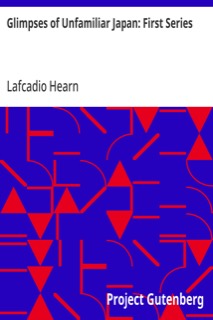
Glimpses of Unfamiliar Japan

by Lafcadio Hearn

Length: 98,527 words, about 394 pages, about 7 hours to read

History and travel, Essays and ideas

Read Glimpses of Unfamiliar Japan free, starting with its best pages and lines below. Listen to it free too, read aloud by your phone's own voice.

The best passages

Pages from the book itself, chosen to make you want to read on. Each opens in the reader at that exact spot.

PREFACE

Sec. 1

It is with the delicious surprise of the first journey through Japanese streets—unable to make one's kuruma-runner understand anything but gestures, frantic gestures to roll on anywhere, everywhere, since all is unspeakably pleasurable and new—that one first receives the real sensation of being in the Orient, in this Far East so much read of, so long dreamed of, yet, as the eyes bear witness, heretofore all unknown. There is a romance even in the first full consciousness of this rather commonplace fact; but for me this consciousness is transfigured inexpressibly by the divine beauty of the day. There is some charm unutterable in the morning air, cool with the coolness of Japanese spring and wind-waves from the snowy cone of Fuji; a charm perhaps due rather to softest lucidity than to any positive tone—an atmospheric limpidity extraordinary, with only a suggestion of blue in it, through which the most distant objects appear focused with amazing sharpness. The sun is only pleasantly warm; the jinricksha, or kuruma, is the most cosy little vehicle imaginable; and the street-vistas, as seen above the dancing white mushroom-shaped hat of my sandalled runner, have an allurement of which I fancy that I could never weary.

Elfish everything seems; for everything as well as everybody is small, and queer, and mysterious: the little houses under their blue roofs, the little shop-fronts hung with blue, and the smiling little people in their blue costumes. The illusion is only broken by the occasional passing of a tall foreigner, and by divers shop-signs bearing announcements in absurd attempts at English. Nevertheless such discords only serve to emphasise reality; they never materially lessen the fascination of the funny little streets.

Keep reading from here

PREFACE

I go in, feeling that soft, spotless, cushioned matting beneath my feet with which the floors of all Japanese buildings are covered. I pass the indispensable bell and lacquered reading-desk; and before me I see other screens only, stretching from floor to ceiling. The old man, still coughing, slides back one of these upon the right, and waves me into the dimness of an inner sanctuary, haunted by faint odours of incense. A colossal bronze lamp, with snarling gilded dragons coiled about its columnar stem, is the first object I discern; and, in passing it, my shoulder sets ringing a festoon of little bells suspended from the lotus-shaped summit of it. Then I reach the altar, gropingly, unable yet to distinguish forms clearly. But the priest, sliding back screen after screen, pours in light upon the gilded brasses and the inscriptions; and I look for the image of the Deity or presiding Spirit between the altar-groups of convoluted candelabra. And I see—only a mirror, a round, pale disk of polished metal, and my own face therein, and behind this mockery of me a phantom of the far sea.

Only a mirror! Symbolising what? Illusion? or that the Universe exists for us solely as the reflection of our own souls? or the old Chinese teaching that we must seek the Buddha only in our own hearts? Perhaps some day I shall be able to find out all these things.

As I sit on the temple steps, putting on my shoes preparatory to going, the kind old priest approaches me again, and, bowing, presents a bowl.

Keep reading from here

Chapter Two The Writing of Kobodaishi

Sec. 2

Now in that time Kobodaishi was wont to meditate alone by the river-side; and one day, while so meditating, he was aware of a boy standing before him, gazing at him curiously. The garments of the boy were as the garments worn by the needy; but his face was beautiful. And while Kobodaishi wondered, the boy asked him: 'Are you Kobodaishi, whom men call "Gohitsu-Osho"—the priest who writes with five brushes at once?' And Kobodaishi answered: 'I am he.' Then said the boy: 'If you be he, write, I pray you, upon the sky.' And Kobodaishi, rising, took his brush, and made with it movements toward the sky as if writing; and presently upon the face of the sky the letters appeared, most beautifully wrought. Then the boy said: 'Now I shall try;' and he wrote also upon the sky as Kobodaishi had done. And he said again to Kobodaishi: 'I pray you, write for me—write upon the surface of the river.' Then Kobodaishi wrote upon the water a poem in praise of the water; and for a moment the characters remained, all beautiful, upon the face of the stream, as if they had fallen upon it like leaves; but presently they moved with the current and floated away. 'Now I will try,' said the boy; and he wrote upon the water the Dragon-character—the character Ryu in the writing which is called Sosho, the 'Grass-character;' and the character remained upon the flowing surface and moved not.

Keep reading from here

Chapter Six

Suddenly a girl rises from her seat, and taps the huge drum once. It is the signal for the Dance of Souls.

Sec. 5

Out of the shadow of the temple a processional line of dancers files into the moonlight and as suddenly halts—all young women or girls, clad in their choicest attire; the tallest leads; her comrades follow in order of stature; little maids of ten or twelve years compose the end of the procession. Figures lightly poised as birds—figures that somehow recall the dreams of shapes circling about certain antique vases; those charming Japanese robes, close-clinging about the knees, might seem, but for the great fantastic drooping sleeves, and the curious broad girdles confining them, designed after the drawing of some Greek or Etruscan artist. And, at another tap of the drum, there begins a performance impossible to picture in words, something unimaginable, phantasmal—a dance, an astonishment.

All together glide the right foot forward one pace, without lifting the sandal from the ground, and extend both hands to the right, with a strange floating motion and a smiling, mysterious obeisance. Then the right foot is drawn back, with a repetition of the waving of hands and the mysterious bow. Then all advance the left foot and repeat the previous movements, half-turning to the left.

Keep reading from here

Chapter Seven The Chief City of the Province of the Gods

But of all places, Kaka-ura! Assuredly I must go to Kaka. Few pilgrims go thither by sea, and boatmen are forbidden to go there if there be even wind enough 'to move three hairs.' So that whosoever wishes to visit Kaka must either wait for a period of dead calm—very rare upon the coast of the Japanese Sea—or journey thereunto by land; and by land the way is difficult and wearisome. But I must see Kaka. For at Kaka, in a great cavern by the sea, there is a famous Jizo of stone; and each night, it is said, the ghosts of little children climb to the high cavern and pile up before the statue small heaps of pebbles; and every morning, in the soft sand, there may be seen the fresh prints of tiny naked feet, the feet of the infant ghosts. It is also said that in the cavern there is a rock out of which comes a stream of milk, as from a woman's breast; and the white stream flows for ever, and the phantom children drink of it. Pilgrims bring with them gifts of small straw sandals—the zori that children wear—and leave them before the cavern, that the feet of the little ghosts may not be wounded by the sharp rocks. And the pilgrim treads with caution, lest he should overturn any of the many heaps of stones; for if this be done the children cry.

Sec. 16

Keep reading from here

10 of the best lines

We owe more to our illusions than to our knowledge.

PREFACEKeep reading from here

And I feel at last the coming of that drowsiness which always follows enchantment.

PREFACEKeep reading from here

For is not the Sea most ancient and most excellent of Speakers—the eternal Poet, chanter of that mystic hymn whose rhythm shakes the world, whose mighty syllables no man may learn?

Chapter Four A Pilgrimage to EnoshimaKeep reading from here

Unto nothing; yet it suggests some fancy of somnambulism—dreamers, who dream themselves flying, dreaming upon their feet.

Chapter SixKeep reading from here

Devoutly do I pray that glass may never become universally adopted in Japan—there would be no more delicious shadows.

Chapter Seven The Chief City of the Province of the GodsKeep reading from here

The sum of the remembered happiness of a lifetime is the creation of seconds.

Chapter NineKeep reading from here

'Of course you cannot understand,' the critic replies; 'it would take you many years of study to understand. And even then—

Chapter ElevenKeep reading from here

None love life more than the Japanese; none fear death less.

Chapter Thirteen ShinjuKeep reading from here

The peasant still worships what he fears.

Chapter Fifteen KitsuneKeep reading from here

The little hands that break the Fox-god's nose in mischievous play can also write essays upon the evolution of plants and about the geology of Izumo.

Chapter Fifteen KitsuneKeep reading from here

All 56 Glimpses of Unfamiliar Japan quotes, with the words around each

Reviews

No reviews yet. Be the first, in the app.

Write a review in Doomreader

Contents

  1. PREFACE
  2. Chapter Two The Writing of Kobodaishi
  3. Chapter Three Jizo
  4. Chapter Four A Pilgrimage to Enoshima
  5. Chapter Five At the Market of the Dead
  6. Chapter Six
  7. Chapter Seven The Chief City of the Province of the Gods
  8. Chapter Eight Kitzuki: The Most Ancient Shrine of Japan
  9. Chapter Nine
  10. Chapter Ten
  11. Chapter Eleven
  12. Chapter Twelve At Hinomisaki
  13. Chapter Thirteen Shinju
  14. Chapter Fourteen Yaegaki-jinja
  15. Chapter Fifteen Kitsune

Listen to Glimpses of Unfamiliar Japan free

Glimpses of Unfamiliar Japan as a free audiobook: Doomreader reads any book aloud, free, in your phone's or computer's own voice. Open the book and tap listen, at the speed you like, hands free.

Want a more natural voice? The AI voices read with AI credits.

Listen free in Doomreader

Download Glimpses of Unfamiliar Japan free

The whole book as an EPUB file, free and legal, from Project Gutenberg. It opens in any ebook app, or read it here in Doomreader with nothing to install.

Download the EPUB (0.3 MB)

More like Glimpses of Unfamiliar Japan

About this edition

Text from Project Gutenberg. In the public domain in the USA. The Project Gutenberg License is kept inside the file. Every passage and line on this page is the book's own words, checked against the text.