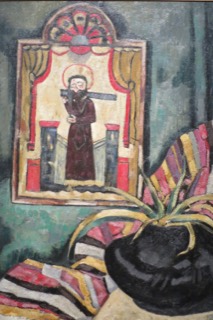
Doomreader

Death Comes for the Archbishop

by Willa Cather

Length: 70,272 words, about 281 pages, about 5 hours to read

Novels

Read Death Comes for the Archbishop free, starting with its best pages and lines below. Listen to it free too, read aloud by your phone's own voice.

What it is

A priest makes the difficult journey from the Great Lakes to the vast territory of 1850s New Mexico to establish a diocese.

The best passages

Pages from the book itself, chosen to make you want to read on. Each opens in the reader at that exact spot.

I: The Cruciform Tree

One afternoon in the autumn of 1851 a solitary horseman, followed by a pack-mule, was pushing through an arid stretch of country somewhere in central New Mexico. He had lost his way, and was trying to get back to the trail, with only his compass and his sense of direction for guides. The difficulty was that the country in which he found himself was so featureless⁠—or rather, that it was crowded with features, all exactly alike. As far as he could see, on every side, the landscape was heaped up into monotonous red sand-hills, not much larger than haycocks, and very much the shape of haycocks. One could not have believed that in the number of square miles a man is able to sweep with the eye there could be so many uniform red hills. He had been riding among them since early morning, and the look of the country had no more changed than if he had stood still. He must have travelled through thirty miles of these conical red hills, winding his way in the narrow cracks between them, and he had begun to think that he would never see anything else. They were so exactly like one another that he seemed to be wandering in some geometrical nightmare; flattened cones, they were, more the shape
Keep reading from here

III: The Bishop Chez Lui

The Bishop laid down his pen and lit his two candles with a splinter from the fire, then stood dusting his fingers by the deep-set window, looking out at the pale blue darkening sky. The evening-star hung above the amber afterglow, so soft, so brilliant that she seemed to bathe in her own silver light. “Ave Maris Stella,” the song which one of his friends at the Seminary used to intone so beautifully; humming it softly he returned to his desk and was just dipping his pen in the ink when the door opened, and a voice said,

“Monseigneur est servi! Alors, Jean, veux-tu apporter les bougies?”

The Bishop carried the candles into the dining-room, where the table was laid and Father Vaillant was changing his cook’s apron for his cassock. Crimson from standing over an open fire, his rugged face was even homelier than usual⁠—though one of the first things a stranger decided upon meeting Father Joseph was that the Lord had made few uglier men. He was short, skinny, bowlegged from a life on horseback, and his countenance had little to recommend it but kindliness and vivacity. He looked old, though he was then about forty. His skin was hardened and seamed by exposure to weather in a bitter climate, his neck scrawny and wrinkled like an old man’s. A bold, blunt-tipped nose, positive chin, a very large mouth⁠—the lips thick and succulent but never loose, never relaxed, always stiffened by effort or working with excitement.

Keep reading from here

II: The Lonely Road to Mora

As they rode up to the door, a man came out, bareheaded, and they saw to their surprise that he was not a Mexican, but an American, of a very unprepossessing type. He spoke to them in some drawling dialect they could scarcely understand and asked if they wanted to stay the night. During the few words they exchanged with him Father Latour felt a growing reluctance to remain even for a few hours under the roof of this ugly, evil-looking fellow. He was tall, gaunt and ill-formed, with a snakelike neck, terminating in a small, bony head. Under his close-clipped hair this repellent head showed a number of thick ridges, as if the skull joinings were overgrown by layers of superfluous bone. With its small, rudimentary ears, this head had a positively malignant look. The man seemed not more than half human, but he was the only householder on the lonely road to Mora.

The priests dismounted and asked him whether he could put their mules under shelter and give them grain feed.

“As soon as I git my coat on I will. You kin come in.”

They followed him into a room where a piñon fire blazed in the corner, and went toward it to warm their stiffened hands. Their host made an angry, snarling sound in the direction of the partition, and a woman came out of the next room. She was a Mexican.

Father Latour and Father Vaillant addressed her courteously in Spanish, greeting her in the name of the Holy Mother, as was customary.

Keep reading from here

II: Stone Lips

Suddenly the snow seemed thinner. The guide stopped short. They were standing, the Bishop made out, under an overhanging wall of rock which made a barrier against the storm. Jacinto dropped the blankets from his shoulder and seemed to be preparing to climb the cliff. Looking up, the Bishop saw a peculiar formation in the rocks; two rounded ledges, one directly over the other, with a mouth-like opening between. They suggested two great stone lips, slightly parted and thrust outward. Up to this mouth Jacinto climbed quickly by footholds well known to him. Having mounted, he lay down on the lower lip, and helped the Bishop to clamber up. He told Father Latour to wait for him on this projection while he brought up the baggage.

A few moments later the Bishop slid after Jacinto and the blankets, through the orifice, into the throat of the cave. Within stood a wooden ladder, like that used in kivas, and down this he easily made his way to the floor.

He found himself in a lofty cavern, shaped somewhat like a Gothic chapel, of vague outline⁠—the only light within was that which came through the narrow aperture between the stone lips. Great as was his need of shelter, the Bishop, on his way down the ladder, was struck by a reluctance, an extreme distaste for the place. The air in the cave was glacial, penetrated to the very bones, and he detected at once a fetid odour, not very strong but highly disagreeable. Some twenty feet or so above his head the open mouth let in grey daylight like a high transom.

Keep reading from here

II: The Lady

Father Joseph soon lost patience and himself approached the widow. “You understand, my child,” he began briskly, “that your husband’s brothers are determined to disregard his wishes, to defraud you and your daughter, and, eventually, the Church. This is no time for childish vanity. To prevent this outrage to your husband’s memory, you must satisfy the court that you are old enough to be the mother of Mademoiselle Inez. You must resolutely declare your true age; fifty-three, is it not?”

Doña Isabella became pallid with fright. She shrank into one end of the deep sofa, but her blue eyes focused and gathered light, as she became intensely, rigidly animated in her corner⁠—her back against the wall, as it were.

“Fifty-three!” she cried in a voice of horrified amazement. “Why, I never heard of anything so outrageous! I was forty-two my last birthday. It was in December, the fourth of December. If Antonio were here, he would tell you! And he wouldn’t let you scold me and talk about business to me, either, Father Joseph. He never let anybody talk about business to me!” She hid her face in her little handkerchief and began to cry.

Father Latour checked his impetuous Vicar, and sat down on the sofa beside Madame Olivares, feeling very sorry for her and speaking very gently. “Forty-two to your friends, dear Madame Olivares, and to the world. In heart and face you are younger than that. But to the Law and the Church there must be a literal reckoning. A formal statement in court will not make you any older to your friends; it will not add one line to your face. A woman, you know, is as old as she looks.”

Keep reading from here

10 of the best lines

The light was full of action and had a peculiar quality of climax⁠—of splendid finish.

PrologueKeep reading from here

“Oh, Indians have nice names too!” Jacinto replied quickly, with a curl of the lip.

II: JacintoKeep reading from here

“A man can do whole lot when they hunt him day and night like an animal. Navajos on the north, Apaches on the south; the Ácoma run up a rock to be safe.”

III: The RockKeep reading from here

He told himself he was listening to one of the oldest voices of the earth.

II: Stone LipsKeep reading from here

But I can still rise upright at the sight of a dollar.

II: The MiserKeep reading from here

A woman, you know, is as old as she looks.

II: The LadyKeep reading from here

Only a Woman, divine, could know all that a woman can suffer.

II: December NightKeep reading from here

Elsewhere the sky is the roof of the world; but here the earth was the floor of the sky.

IV: EusabioKeep reading from here

“Very well,” replied Father Joseph, “then God will send me an oxcart.”

III: Auspice Maria!Keep reading from here

There is always something charming in the idea of greatness returning to simplicity⁠—the queen making hay among the country girls

Chapter IVKeep reading from here

All 33 Death Comes for the Archbishop quotes, with the words around each

Reviews

No reviews yet. Be the first, in the app.

Write a review in Doomreader

Contents

All 41 parts
  1. Prologue
  2. Book I: The Vicar Apostolic
  3. I: The Cruciform Tree
  4. II: Hidden Water
  5. III: The Bishop Chez Lui
  6. IV: A Bell and a Miracle
  7. Book II: Missionary Journeys
  8. I: The White Mules
  9. II: The Lonely Road to Mora
  10. Book III: The Mass at Ácoma
  11. I: The Wooden Parrot
  12. II: Jacinto
  13. III: The Rock
  14. IV: The Legend of Fray Baltazar
  15. Book IV: Snake Root
  16. I: The Night at Pecos
  17. II: Stone Lips
  18. Book V: Padre Martínez
  19. I: The Old Order
  20. II: The Miser
  21. Book VI: Doña Isabella
  22. I: Don Antonio
  23. II: The Lady
  24. Book VII: The Great Diocese
  25. I: The Month of Mary
  26. II: December Night
  27. III: Spring in the Navajo Country
  28. IV: Eusabio
  29. Book VIII: Gold Under Pike’s Peak
  30. I: Cathedral
  31. II: A Letter from Leavenworth
  32. III: Auspice Maria!
  33. Book IX: Death Comes for the Archbishop
  34. Chapter I
  35. Chapter II
  36. Chapter III
  37. Chapter IV
  38. Chapter V
  39. Chapter VI
  40. Chapter VII
  41. Chapter VIII

Listen to Death Comes for the Archbishop free

Death Comes for the Archbishop as a free audiobook: Doomreader reads any book aloud, free, in your phone's or computer's own voice. Open the book and tap listen, at the speed you like, hands free.

Want a more natural voice? The AI voices read with AI credits.

Listen free in Doomreader

Download Death Comes for the Archbishop free

The whole book as an EPUB file, free and legal, from Standard Ebooks. It opens in any ebook app, or read it here in Doomreader with nothing to install.

Download the EPUB (1.0 MB)

More by Willa Cather

More like Death Comes for the Archbishop

About this edition

Text from Standard Ebooks. Standard Ebooks dedicate their edition to the public domain (CC0 1.0). Every passage and line on this page is the book's own words, checked against the text.